
5 Signs You Need a Commercial Liquidation Partner, Not a Junk Removal Company
Most Canadian businesses hire a junk removal company when they actually need a liquidation partner. Five signs you are using the wrong vendor and what to do about it.
5 Signs You Need a Commercial Liquidation Partner, Not a Junk Removal Company
Most Canadian businesses hire a junk removal company when they actually need a liquidation partner. The two vendor categories look similar from the outside (trucks, crews, lifting, hauling) but they solve different problems. Junk removal moves inventory off your loading dock as fast as possible. A commercial liquidation partner recovers value, manages compliance, and produces documentation. On a meaningfully sized commercial decommissioning, the difference is usually a five-figure swing in net outcome and a defensible audit trail.

Sign 1: You Are Paying to Dispose of Items That Still Have Resale Value
The clearest signal that you are using the wrong vendor is when the quote treats every asset the same. Junk removal companies price by truckload, weight, or square footage. Their economic model is to get the load gone as quickly as possible. They do not maintain buyer networks, photograph assets, or list items for resale. Anything in the load that could have been sold becomes part of the disposal stream.
A liquidation partner sorts before it hauls. Premium task chairs from recognized brands (Herman Miller, Steelcase, Haworth) carry real secondary-market value. National refurbishers list used Herman Miller Aerons at $350 to $850 each depending on configuration, and the same secondary-market dynamics apply across sit-stand desks, modular workstations, and other recognized office furniture. If your current vendor's quote shows a disposal cost with no recovery line, you are paying twice: once for the haul, and again in lost asset value.
Sign 2: You Cannot Verify Where Things Actually Went
The second signal lives in the documentation. When a junk removal company finishes a project, the deliverable is typically an invoice and possibly a transfer station receipt. There is no asset list, no chain of custody, no breakdown of what was resold versus recycled versus landfilled, and no per-stream weight reporting.
A liquidation partner produces a final disposition report that reconciles the inventory line by line:
- Items resold, with buyer destinations
- Items donated, with charity recipient names
- Items recycled, with material types and weights
- Items disposed of, with tipping receipts
For businesses reporting under SASB, GRI, or CDP frameworks, the disposition report feeds the waste-to-landfill disclosure. For businesses under SOC 2 or ISO 27001 audit, it is the documentation an auditor expects to see. If your current vendor cannot produce this on request, the gap is a control failure, not a paperwork inconvenience.
Sign 3: Your IT Equipment Goes Out With Everything Else
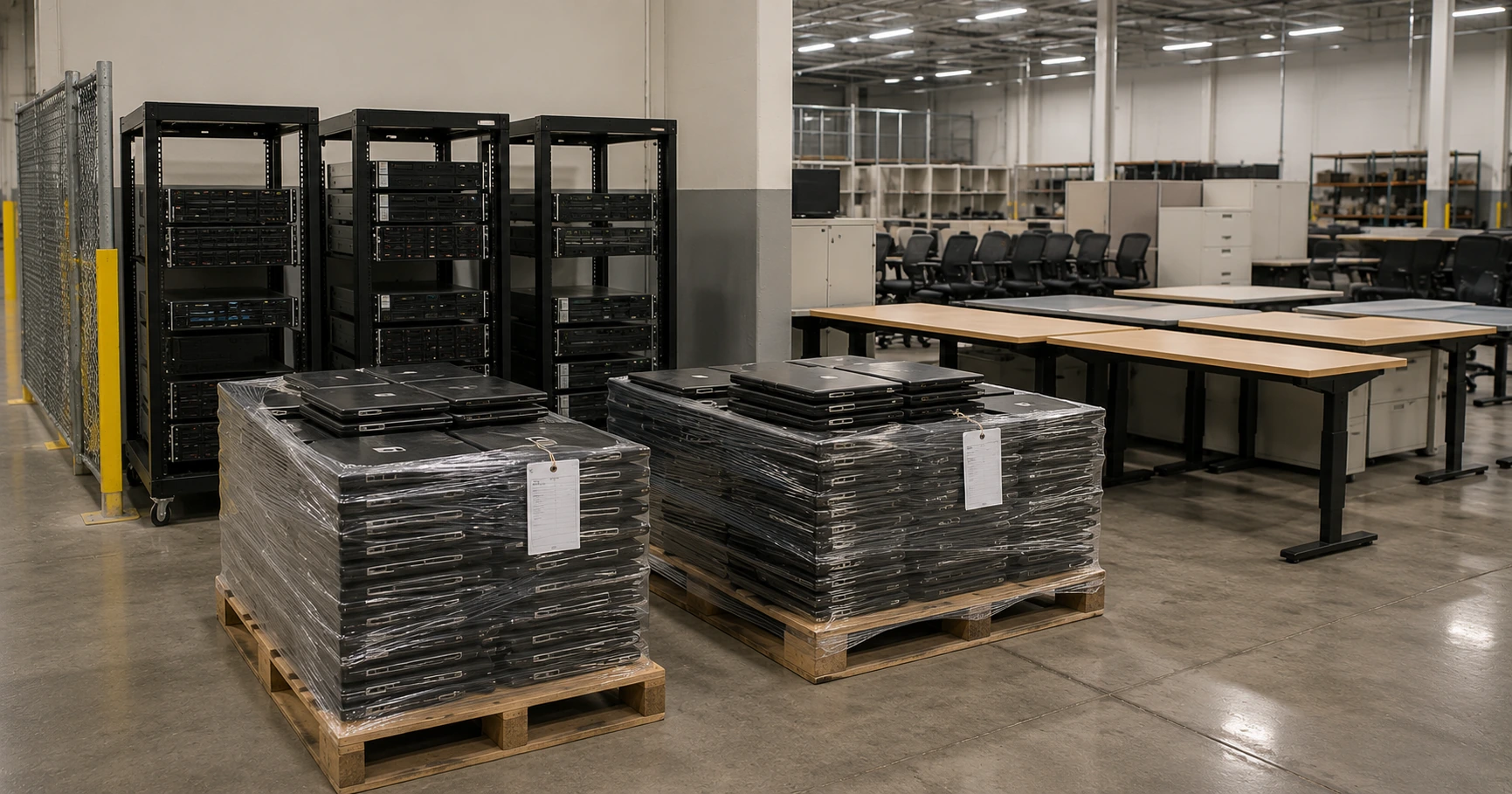
The third signal is the IT problem. Junk removal companies routinely accept laptops, desktops, monitors, servers, copiers with hard drives, and networked devices as part of a general clear-out. They are not licensed for certified data destruction, do not produce Certificates of Destruction, and do not operate within Canada's provincial EPR programs for regulated electronics.
The financial exposure is real. IBM's 2024 Cost of a Data Breach Report puts the average breach cost in Canada at CA$6.32 million, and equipment-disposal-originated breaches are among the most preventable categories on that list. Under PIPEDA, the Office of the Privacy Commissioner's safeguards guidance requires disposal methods that prevent unauthorized parties from gaining access to personal information. A laptop sent to a recycler with the hard drive still readable is a breach event regardless of whether the recycler is provincially approved for the physical disposal.
A liquidation partner with IT asset disposition capability follows NIST Special Publication 800-88 Revision 2 for media sanitization, operates within RPRA, ARPE-Québec, Encorp, and ARMA channels for the regulated provincial e-waste programs, and produces both Certificates of Destruction and chain-of-custody documentation. If your IT goes out the door on the same truck as your conference tables, your current vendor is not doing this work.
Sign 4: The Quote Did Not Ask About Asset Mix, ESG Goals, or Lease Clauses
The fourth signal is in the scoping conversation. A junk removal quote takes the form: "How many truckloads? When can we be there? Here is the price." A liquidation partner's quote takes the form of a walkthrough: inventory count, brand and condition assessment, recovery estimate, and a discussion of timeline against your lease-end deadline and any restoration obligations.
The walkthrough difference matters because the right plan depends on inputs a transactional quote does not capture:
- ESG-reporting companies need landfill diversion documentation.
- Tenants with restoration clauses need reinstatement coordinated with the removal.
- IT in the mix needs the certified destruction workflow.
- Companies with charitable donation goals need office furniture donation routing built into the project.
If your scoping conversation with a current vendor took 15 minutes and produced a single per-truckload price, you are not getting the planning the project actually needs.
Sign 5: You Are Solving for "Fastest Possible," Not "Best Outcome"
The fifth signal is the framing. Junk removal services compete on speed and price: same-day pickup, lowest quote, fewest questions. The implicit promise is that the problem disappears in 72 hours.
That framing fits residential clean-outs and small commercial junk. It does not fit a multi-station office decommissioning, a warehouse closure, or a multi-floor right-sizing. Those projects benefit from time: a multi-week sales cycle that captures resale value, a coordinated donation routing that captures charitable receipts, and a measured drawdown that maintains chain of custody. The fastest path through a commercial liquidation is also typically the most expensive on net. If your current vendor's pitch is "we can be there tomorrow" and not a transparent quote showing cost, recovery, and net, the offering is built for a different problem than the one you actually have.
What to Do If You Recognize the Pattern
These signs are not theoretical. They are the recurring pattern in projects Michael's Global Trading is asked to review after a previous vendor has finished. The typical narrative: facilities engaged a junk removal vendor on price and turnaround, the project completed, and the CFO or sustainability officer raised a question the existing engagement could not answer.
For the current project, the salvageable inventory still on the floor can be re-routed through a liquidation workflow if engagement happens before the disposal vendor finishes hauling. For future projects, vendors should be evaluated on the walkthrough quality, the recovery estimate, the documentation deliverables, and the certifications relevant to the asset mix. Our commercial asset liquidation work covers Toronto and the GTA, Ottawa, Montreal, and businesses across Canada, and our written estimate separates the disposal cost from the resale recovery so the business sees what nets out before any work starts.
Frequently asked questions
Is a liquidation partner always more expensive upfront than junk removal?
No, often less expensive on net. Junk removal quotes look cheaper on the line but do not subtract recovery from resale or capture donation receipts. The right comparison is net cost across both options, which a walkthrough quote can produce for either path.
Can I use junk removal for the disposal portion and a liquidation partner for the resale portion?
In principle yes, but the coordination cost typically eats the savings. A liquidation partner that handles the whole project sorts once and produces unified documentation. Splitting the work means double-handling and two sets of paperwork that do not reconcile cleanly.
What documentation should I expect from a commercial liquidation engagement?
At minimum: inventory list with serial numbers and condition, chain-of-custody transfers for data-bearing IT, Certificates of Destruction for those devices, charitable receipts from donation recipients, and a final disposition report showing per-stream weights or unit counts.
How do I evaluate whether my current vendor has the right certifications?
For IT: ask about R2 or RIOS certification, NIST 800-88 compliance, and provincial program registration (RPRA in Ontario, ARPE-Québec in Quebec, Encorp in BC, ARMA in Alberta). For office furniture: ask whether they coordinate donation routing with registered charities and provide receipts. A vendor that cannot answer these questions directly is not a liquidation partner.
What is the minimum project size where a liquidation partner makes sense?
There is a project-size threshold below which disposal economics may beat liquidation on pure dollars, because the liquidator's mobilization cost does not amortize over enough inventory. Above that threshold, the recovery side typically wins. The exact threshold depends on the asset mix and brand quality.
Quick Recap
- Resale value left behind: Junk removal does not sort or sell. Liquidation captures the recovery side.
- Documentation gap: Junk removal delivers an invoice. Liquidation delivers a final disposition report.
- IT compliance risk: Junk removal is not licensed for certified data destruction; the PIPEDA exposure on a single missed laptop is material.
- Scoping signal: A vendor that does not ask about asset mix, ESG goals, or lease clauses is built for the wrong problem.
- Framing signal: "Fastest possible" is the wrong objective above a meaningful project size. Net outcome is the right one.
Ready to Switch From Junk Removal to a Real Liquidation Partner
If three or more of the five signs above describe your current vendor relationship, your project is leaving recovery on the table and exposing the business to documentation gaps. Michael's Global Trading provides commercial asset liquidation to businesses across Toronto, the GTA, Ottawa, Montreal, and the rest of Canada. Contact us to walk your space and get a written estimate that shows cost, recovery, and net before any work starts.
Recommended readings
What Does a Commercial Liquidation Company Actually Do? A Process Breakdown
DIY Liquidation vs Professional Service: Which Path Guarantees Maximum Commercial Asset Recovery
Recommended readings:


Blogs & News


Get started on
your journey with us.