
How Office Furniture Liquidation Supports Corporate ESG and Sustainability Goals
How office furniture liquidation contributes to ESG metrics, diversion targets, circular economy goals, and Scope 3 emissions reporting for Canadian businesses.
How Office Furniture Liquidation Supports Corporate ESG and Sustainability Goals
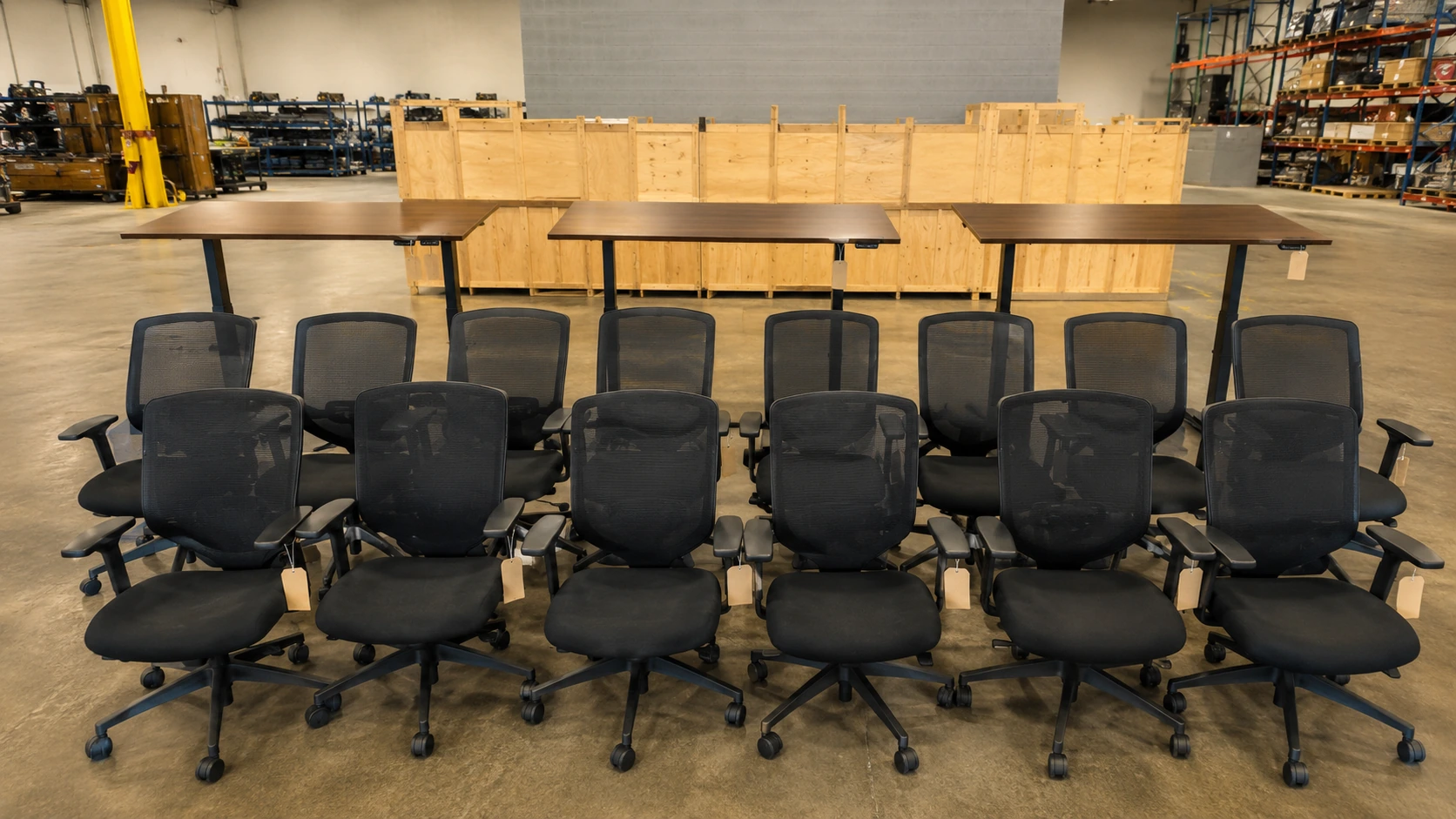
For Canadian companies reporting under SASB, GRI, CDP, or TCFD, office furniture decommissioning has moved from a facilities decision to an ESG one. Capital markets, customers, and ratings agencies are asking detailed questions about waste-to-landfill rates, circular economy contribution, and Scope 3 emissions from operations. A major office decommissioning that sends most of its furniture to landfill is now a material disclosure event. The same project handled as a liquidation can be a reportable contribution to diversion targets, donation impact, and embodied-carbon reduction.
Why Office Furniture Has Become an ESG Concern
Five years ago, office furniture decommissioning was a budget line in the facilities operating plan. The conversation was about cost, schedule, and lease compliance. The conversation about environmental impact happened, if at all, after the dumpsters were already loaded.
That has changed in three directions. First, the hybrid-work right-sizing wave has moved the volume of office furniture in the disposal stream from incidental to material. U.S. EPA data shows furniture and furnishings generated 12.1 million tons of U.S. municipal solid waste in 2018, with 80.1% landfilled; comparable Canadian aggregate data is less granular but reflects broadly similar disposal patterns. The aggregate quantity has made the category visible to environmental disclosures that previously focused on more obvious operational emissions.
Second, the major ESG reporting frameworks now explicitly request waste-to-landfill data at the operational level. SASB's Real Estate Services and Engineering & Construction standards include waste metrics. GRI 306 (Waste) was updated in 2020 with detailed disclosure requirements, effective 1 January 2022. CDP's Climate Change questionnaire asks about Scope 3 emissions from waste generated in operations. TCFD-aligned reporting has pulled physical waste data into the broader risk and transition narrative.
Third, the procurement chain has started auditing it. Large Canadian customers and ESG-rated investors are issuing vendor questionnaires that ask suppliers to document waste-handling practices, including office decommissioning. A supplier that cannot answer is a flag.
How Liquidation Maps to ESG Metrics
Office furniture liquidation, as a decommissioning approach, produces measurable contributions across the major ESG metric categories.
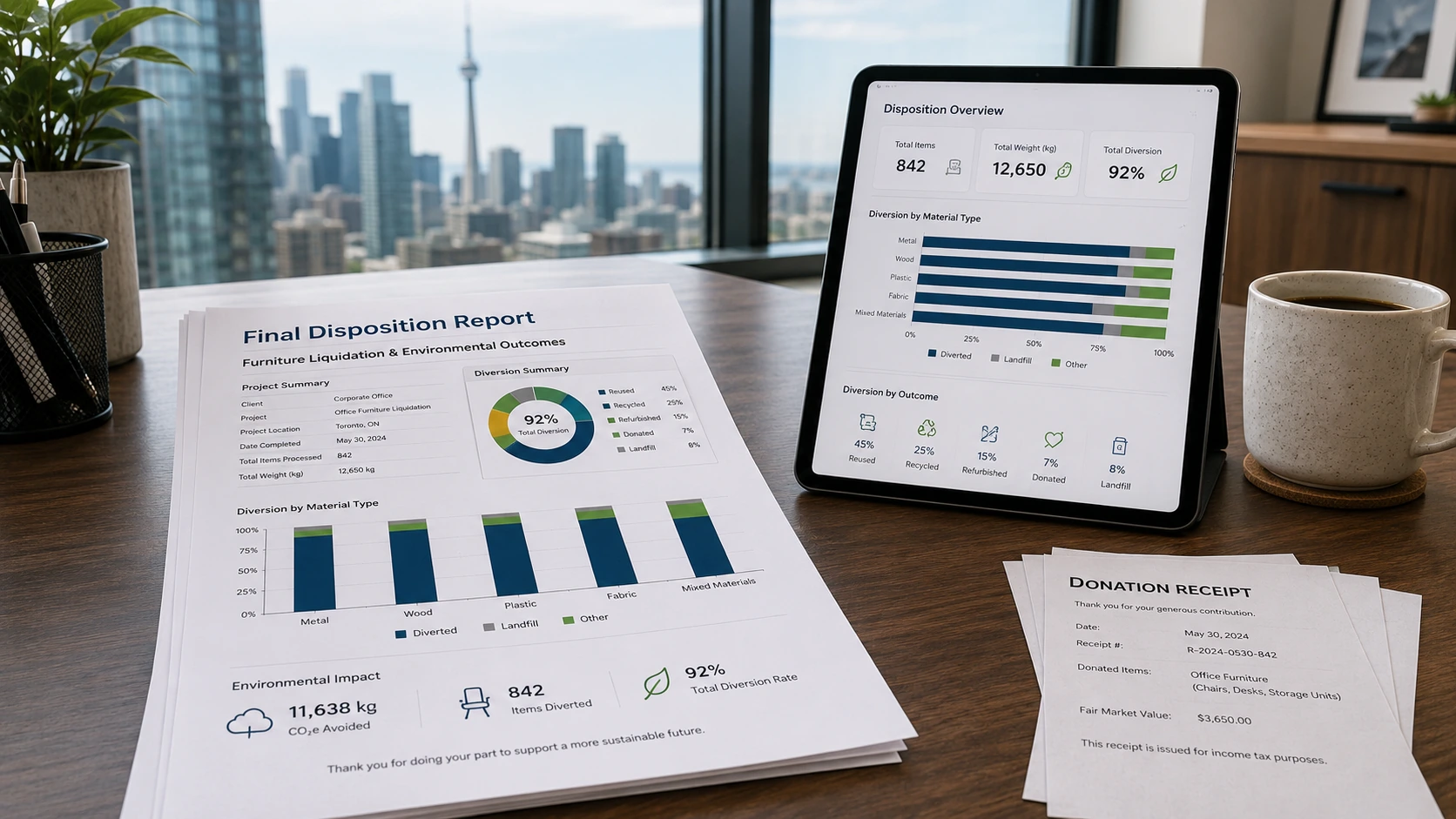
Landfill diversion is the most direct. A liquidation engagement routes inventory through resale, donation, and certified recycling rather than directly to landfill, and the diversion percentage is documented in the liquidator's final disposition report. That percentage feeds directly into the waste-to-landfill disclosure under SASB and GRI 306.
Circular economy contribution is captured through the resale and donation streams. Resold furniture extends the useful life of the asset, displacing demand for new manufacturing and the embodied carbon associated with it. Donated furniture flows to charitable organizations that would otherwise have to purchase new. Both reduce the project's net embodied-carbon footprint relative to a disposal-only baseline.
Scope 3 emissions are reduced through the same mechanism. Office furniture has substantial embodied carbon in the steel, aluminum, plastics, and engineered wood used in manufacture. Reuse and resale displace new production, which translates into measurable Scope 3 reductions for the originating organization. The exact figures vary by asset type, but reuse generally yields more carbon benefit per item than recycling because it avoids both the production emissions of a replacement and the energy required to process the original through a recycling stream.
Community impact is captured on the donation side. Donations to registered Canadian charities (Habitat for Humanity ReStores, the Furniture Bank network, regional furniture banks) generate measurable community-benefit data: pieces of furniture redistributed, households served, charitable-receipt value. This data feeds CSR reporting and the social dimension of ESG ratings.
Quantifying Embodied Carbon
The Scope 3 carbon estimate is harder to pin precisely without a project-specific assessment. Published Environmental Product Declarations and life-cycle assessments place embodied carbon for individual office furniture components in a wide range: Herman Miller's published EPD puts the Aeron chair at 87 kg CO2-equivalent per unit, while a University of Michigan life-cycle assessment of Steelcase office furniture reports 219 kg CO2-equivalent for a work surface and 230 kg for a panel. Workstation-level totals depend on configuration but commonly land in the range these component figures suggest. Extending useful life through resale or donation displaces a meaningful share of that embodied carbon, with the exact reduction depending on the avoided new-furniture purchase.
The Donation Lever
Donation is the highest-impact stream for the social dimension of ESG reporting because it generates environmental and social outcomes simultaneously. A Canadian business that routes meaningful inventory through the office furniture donation network captures three reportable outcomes: tonnes diverted from landfill, charitable receipts issued at fair market value (offsetting taxable income), and community benefit data from the receiving organizations.
The major Canadian receivers (Habitat for Humanity ReStores across most provinces, the Furniture Bank network in Toronto, Edmonton, and Halifax, HomeStart Foundation in Vancouver, Renaissance Quebec in Montreal) all produce intake documentation that can be used as primary evidence in CSR reporting. The receipts are issued by the registered charity itself, which provides a more defensible documentation chain than self-attestation by the donor.
For multi-province companies, a coordinated donation program across markets generates a single national impact report. The reporting consolidation matters because it allows the sustainability team to present aggregate numbers (households served, tonnes redistributed, value donated) at the corporate level rather than as a scatter of project-level data.
Building ESG-Grade Documentation
ESG reporting on a decommissioning project requires documentation that survives an audit. The minimum bar:
- An inventory with item-level detail (serial numbers where applicable, asset type, quantity, condition) at the start of the project
- A final disposition report that reconciles the inventory across streams (resold, donated, recycled, disposed) with weights or unit counts per stream
- Receipts from receiving organizations: buyers for resale, charities for donations, processors for recycling
- A landfill diversion percentage calculated from the disposition data
- Optional: a Scope 3 carbon estimate based on the avoided-emissions methodology the organization uses
The documentation should reconcile end-to-end. Every item on the original inventory should be accounted for in the final disposition report. Gaps in reconciliation are findings in an ESG audit, and they are also the most common reason a well-intentioned decommissioning project produces weaker reportable data than it should.
The Business Case
The financial case for ESG-aligned liquidation has converged with the financial case for liquidation generally. For most Canadian commercial offices of meaningful size, liquidation produces a net financial gain through resale recovery. The ESG benefit comes on top of that financial outcome, not at the expense of it.
The result is one of the rare ESG initiatives where the reportable-impact case and the financial case point the same direction. Sustainability officers and CFOs are arguing for the same outcome with different vocabularies. The work of the decommissioning team is to deliver both outcomes in a single engagement with documentation that satisfies both audiences.
How Michael's Global Trading Supports ESG-Aligned Decommissioning
Michael's Global Trading operates sustainable office decommissioning as the default engagement model for larger projects. The walkthrough produces an inventory and a recovery estimate. The execution routes inventory through resale, donation, recycling, and disposal in that order, with landfill diversion reporting built into the final disposition document.
The deliverable package is designed for ESG reporting consumption: itemized disposition data per stream, diversion percentage, charitable receipts from registered Canadian charities, processor receipts from R2-aligned recyclers, and a summary suitable for inclusion in SASB or GRI waste disclosures. Multi-province engagements consolidate into a single reporting package, so the corporate sustainability team gets one document instead of a scatter of project-level files.
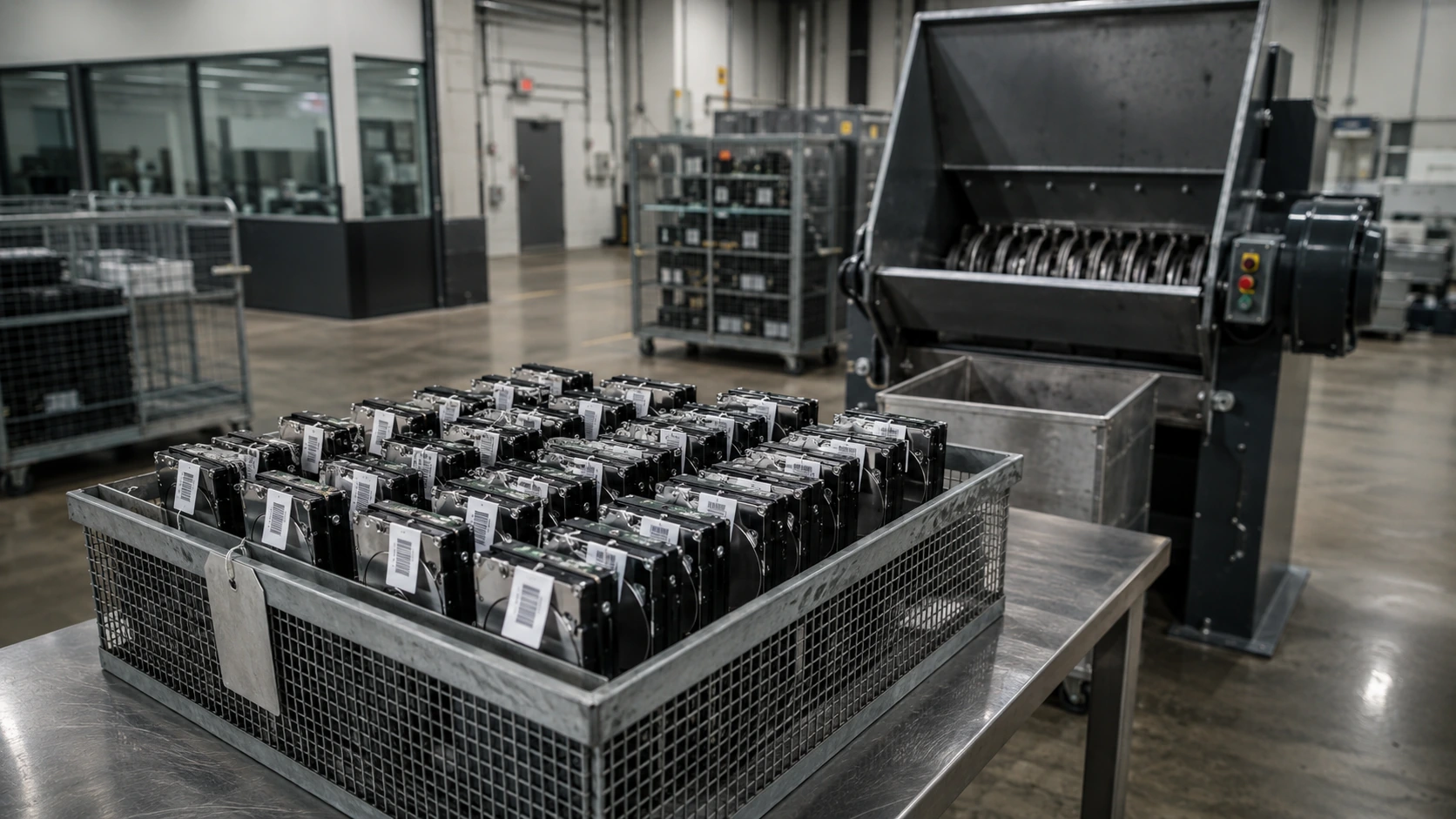
For electronics in the mix, certified e-waste recycling operates alongside the furniture work, with chain-of-custody documentation that satisfies the same ESG-reporting standard.
Frequently asked questions about ESG and office furniture liquidation
Which ESG frameworks have waste-to-landfill disclosure requirements?
SASB's Real Estate Services and Engineering & Construction standards, GRI 306 (Waste), and CDP's Climate Change questionnaire all include waste-related disclosures. TCFD-aligned reporting also pulls physical waste data into the broader risk narrative. Most large Canadian companies report under one or more of these frameworks.
What landfill diversion rate is considered strong in commercial decommissioning?
The strongest results come from engagements that route through resale and donation before falling back on recycling, with disposal as the last resort. The actual percentage on any project depends on the asset mix, the condition of the inventory, and the runway available before the deadline.
Can I claim Scope 3 emissions reductions from a decommissioning project?
Yes, with the right methodology. The avoided-emissions approach captures the embodied carbon displaced through resale and donation. Estimates vary by asset type and the methodology used. A qualified sustainability advisor or the organization's existing Scope 3 framework should produce the specific calculation.
Does donation produce stronger ESG outcomes than resale?
For the social dimension (community impact), yes. For the environmental dimension (waste diversion and Scope 3), the two streams are roughly equivalent: both keep material out of landfill and displace new production. The choice is usually driven by the asset type and the project timeline.
How long does it take to produce ESG-grade documentation on a decommissioning project?
Final documentation is typically delivered after the receiving organizations (charities, recyclers, buyers) confirm their intake and issue their receipts. Multi-province projects can take longer to consolidate than single-site engagements.
Are there published benchmarks for office furniture embodied carbon?
Yes, in published Environmental Product Declarations from manufacturers and academic life-cycle assessments. Component-level figures vary widely depending on construction profile. Most Scope 3 calculations use either a category-average estimate from EPA or Ecoinvent databases or a manufacturer-specific EPD where available.
Quick Recap
- ESG frameworks now require waste data: SASB, GRI 306, CDP, and TCFD all include waste-to-landfill disclosure.
- Liquidation maps to four metric categories: Landfill diversion, circular economy contribution, Scope 3 emissions reductions, and community impact.
- Embodied carbon is real and quantifiable: Published EPDs and LCAs put office furniture components in a wide range that depends on construction profile.
- Documentation is the deliverable: Inventory, per-stream disposition data, receipts from receiving organizations, and a landfill diversion percentage.
- Financial and ESG outcomes align: Liquidation produces a net financial gain on most mid-size and larger projects, with the ESG impact on top.
Ready to Plan an ESG-Aligned Decommissioning
Office furniture liquidation is one of the few operational decisions where financial recovery and ESG impact point the same direction. Michael's Global Trading provides sustainable office decommissioning to businesses across Toronto, the GTA, Ottawa, Montreal, and the rest of Canada, with documentation built for SASB, GRI, and CDP reporting. Contact us to walk your space and get a project plan that delivers the financial outcome and the reportable impact your sustainability team needs.
Recommended readings
Office Furniture Liquidation vs. Disposal: A Cost Comparison for Canadian Businesses
How Hybrid Work Is Creating a Commercial Furniture Surplus Crisis in Canada
Recommended readings:

Blogs & News


Get started on
your journey with us.