
How Remote Work is Shaping the Demand for Office Furniture and Equipment
Explore how remote and hybrid work affect furniture and equipment needs, from home workstations and shared desks to reusing surplus office assets.
How Remote Work Is Shaping the Demand for Office Furniture and Equipment
Remote work changes the mix of furniture and equipment a business needs, not just the quantity. Home offices need suitable seating and dependable technology. Shared workplaces need furniture that supports different users and activities. Together, these requirements shift purchasing priorities away from furnishing one permanent workstation for every employee.
For businesses, the practical question is what each location needs to support the work happening there. Establish that before purchasing replacements or clearing existing assets. A change in attendance should prompt an inventory review, not an automatic decision to buy everything new or sell everything unused.
Home Office Furniture Is Part of the Operating Plan
A home workspace should be assessed as a place where regular work happens, rather than a temporary arrangement that employees must make do with. The Canadian Centre for Occupational Health and Safety (CCOHS) recommends comparable-quality desks, chairs, and accessories to those available at the workplace, with equipment properly arranged and adjusted.
For employers, start by identifying what employees already have and what prevents them from working comfortably. Resolve who will provide the missing furniture and technology. CCOHS specifically identifies responsibility for supplying desks, chairs, computers, and monitors as something employers and workers should establish when arranging remote work.
Use that assessment to make targeted purchases. The objective is a functional workstation, not an identical shopping list for every household.
Ergonomic Furniture: Fit Matters More Than the Label
An “ergonomic” chair is not automatically suitable for everyone. CCOHS explains that the chair must fit the person, the workstation, and the tasks being performed. Seat dimensions, adjustment range, and back support matter more than the product description alone.
Assess the workstation as a complete setup:
- Seating: Check seat height and depth, lumbar support, and whether the armrests allow the user to sit comfortably at the desk. Where practical, let the employee try the chair before selecting it.
- Work surface: A sit-stand desk allows changes between sitting and standing. Its purpose is to support changes in position, not replace prolonged sitting with prolonged standing.
- Screen placement: Position the monitor to support a comfortable viewing angle and distance. Assess a monitor stand or adjustable support against the actual desk arrangement rather than adding it as a standard accessory without checking the fit.
This changes the purchasing decision from “Which chair should we order?” to “What needs to change about this workstation?”
Functional Home Offices Need Furniture That Fits the Space
Remote work also brings space constraints into furniture selection. Compact desks, integrated storage, and foldable furniture are options for creating a work area without permanently occupying an entire room.
Measure the usable area before choosing furniture. Include space for the chair to move and for the equipment needed during a normal workday. Check the workstation while it is in use, not only how neatly it can be stored afterwards.
For example, when evaluating a folding desk, check whether it accommodates the employee’s screen and input devices in a workable position. Treat compactness as one requirement alongside usability, not the overriding objective.
Technology Demand Extends Beyond the Computer
Remote collaboration brings attention to equipment beyond the laptop itself. Webcams, headphones, external monitors, and networking equipment all form part of the home-office requirements discussed in MGT’s original guide.
Match those purchases to the employee’s work. For someone who spends much of the day in virtual meetings, assess audio, camera placement, and connection reliability together. For screen-intensive work, establish the display requirements before selecting a desk or monitor support.
Avoid assuming the most expensive configuration is the most useful. Identify the problem the purchase needs to solve, then confirm that the proposed equipment addresses it.
Connecting and Collaborating Across Locations
Test the complete working arrangement before treating it as finished. Can the employee join meetings reliably? Is the equipment positioned comfortably? Can they work without repeatedly rearranging the room?
CCOHS identifies internet access, control over noise and lighting, and an appropriate place to concentrate as elements of a suitable home-office environment. It also notes that noise-cancelling headphones may help where background noise cannot otherwise be controlled.
A functioning device is only one part of a functioning workspace. Budget for the arrangement that makes the equipment useful.
Traditional Offices Need More Adaptable Layouts
Hybrid work also changes the role of the shared office. Modular furniture, movable partitions, and collaboration areas provide alternatives to a layout built entirely around fixed individual desks.
Start with the activities the office needs to support. Identify where employees will work independently, where teams will meet, and which spaces need to accommodate both.
As a design reference, the Government of Canada’s GCworkplace approach uses activity-based working, with access to different shared spaces according to the task. The relevant principle is to select furniture around how a space will be used, rather than assign every activity to the same workstation.
Before replacing the existing fit-out, test what can be rearranged. Give each retained item a place in the proposed layout so the purchasing plan reflects genuine gaps.
Hot Desking and Shared Resources
Hot desking replaces permanently assigned desks with workstations used by different employees. That makes adjustability important. CCOHS notes that shared workstations can create problems when they do not fit the user or are not adjusted at the start of a shift.
For planning purposes, assess both capacity and usability. Check how many employees need desks at the same time, then confirm that the available stations can accommodate them.
Apply the same approach to shared printers and meeting-room equipment. Determine where the equipment is needed and who depends on it before removing duplicates. The objective is to reduce unnecessary inventory without creating avoidable competition for essential resources.
Eco-Friendly Solutions Include What Happens to Existing Assets
Sustainable procurement should consider useful life and repairability alongside the next purchase. The UN’s Global E-waste Monitor 2020 identified short product lifecycles and limited repair options among the factors contributing to electronic waste. That supports evaluating how long equipment can remain useful, not just its initial specifications.
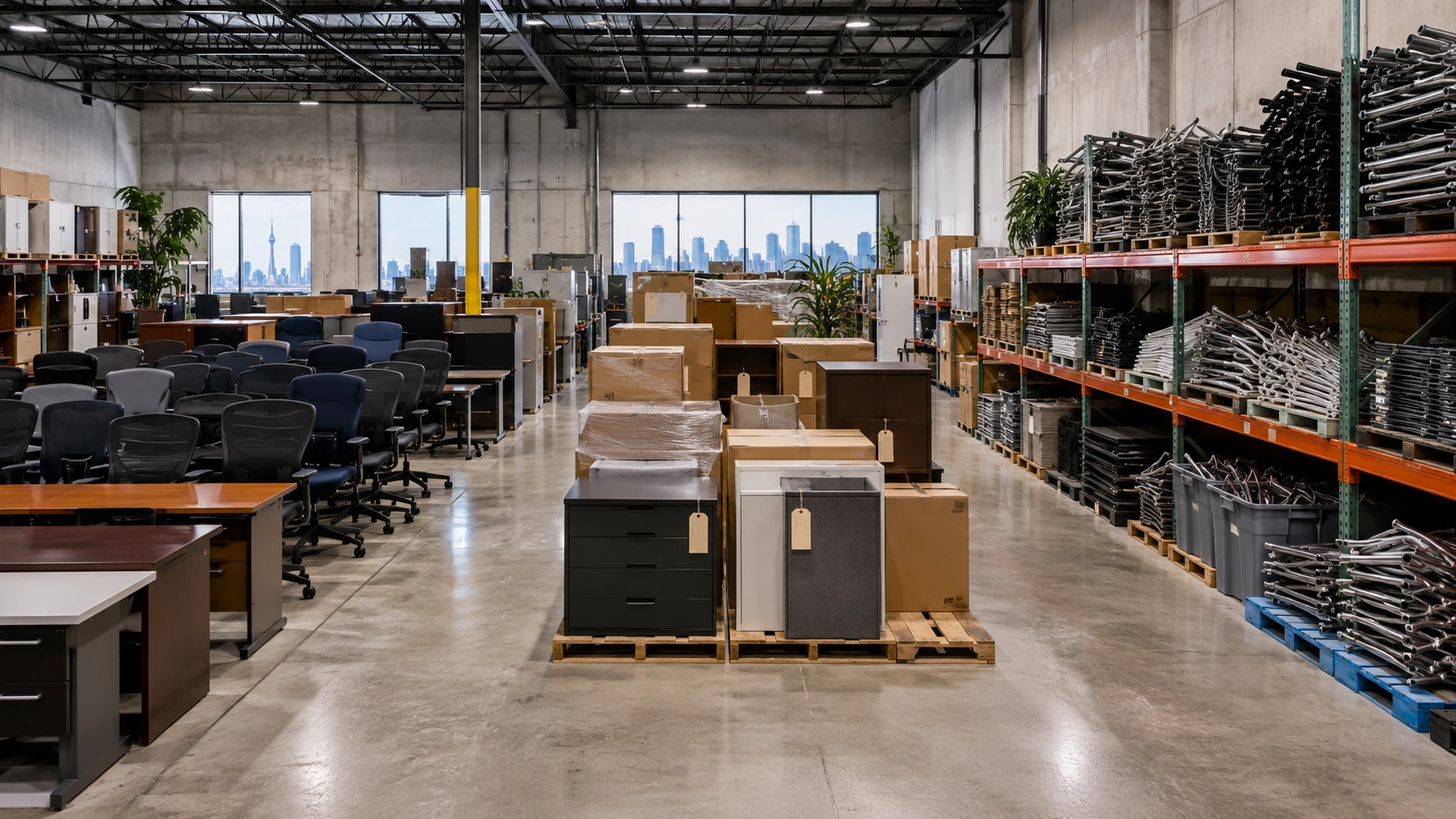
For furniture, review whether existing pieces can support the revised workplace or another user before treating them as waste. Michael’s Global Trading’s eco-friendly disposal service includes sorting furniture for reuse, donation, and recycling. Those routes provide alternatives when items are no longer needed in their current location.
Keep outgoing assets within the transition plan. Decide what remains in use, what can be reassigned, and what needs an external destination before new furniture arrives.
Frequently Asked Questions About Remote-Work Furniture and Equipment
Does hybrid work automatically mean a business needs fewer desks?
Not necessarily. Base the decision on how many employees need workstations simultaneously, including planned team days. A weekly attendance average is not enough to establish whether the office has adequate capacity on its busiest days.
Can existing office furniture be provided to employees working from home?
That can be an option. CCOHS notes that employers may provide or lend equipment, including ergonomic chairs and technology, to support home workspaces. Confirm suitability for the employee’s setup before arranging the transfer.
Should employees try ergonomic furniture before it is purchased?
Where practical, yes. CCOHS recommends allowing users to test suitable chairs in a real working situation before making the final selection. The assessment should consider the person and their work, not just the chair’s advertised features.
Ready to Reassess Your Office Furniture Inventory?
A remote or hybrid transition should begin with a clear view of what your business still needs. Once the revised layout and employee requirements are established, the remaining furniture can be assessed for liquidation or another appropriate destination.
Michael’s Global Trading provides office furniture liquidation across Toronto and Canada, including support for businesses transitioning to remote setups. We assess the inventory and its resale potential, then plan the agreed sale and removal work around the project’s requirements.
Contact us with photographs, an inventory, and your required completion date. Identify what will remain in the office or be reassigned to employees, and we’ll assess the outgoing assets.
Recommended Readings
Office Furniture Disposal Costs Exposed: Landfill Fees, Labour, and Lost Value examines the costs and potential recovery to consider when clearing surplus furniture.
How Office Furniture Liquidation Supports Corporate ESG and Sustainability Goals explores furniture reuse, diversion pathways, and project documentation.
Recommended readings:

Blogs & News



Get started on
your journey with us.