
Office Furniture Disposal Costs Exposed: Landfill Fees, Labour, and Lost Value
What office furniture disposal actually costs in Canada: tipping fees, labour, transport, hidden surcharges, and the recovery value most quotes leave on the floor.
Office Furniture Disposal Costs Exposed: Landfill Fees, Labour, and Lost Value
For a Canadian business hiring a disposal vendor to clear out an office, the headline price on the quote is not the cost. The cost is the headline plus the hidden surcharges added at invoicing, the post-pickup landfill fees passed through unmarked, and the recovery value left on the floor when furniture that could have sold goes straight into the truck. The line items below explain how the real cost of an office furniture disposal project gets built, and why two vendors quoting the same headline number can produce very different final invoices.
The Three Core Line Items
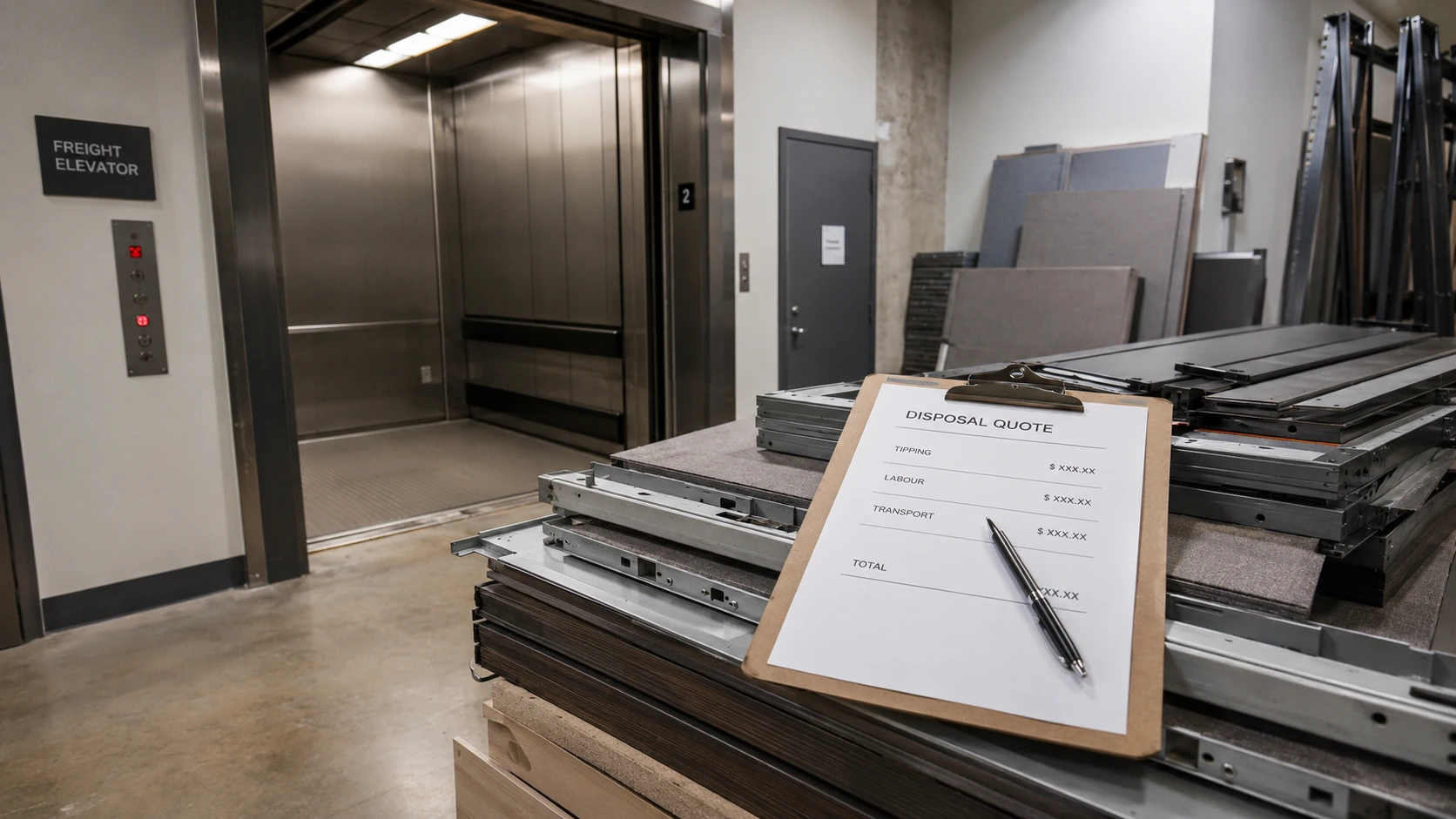
A disposal quote in Canada is built from three line items: tipping fees, labour, and transport. Together they account for most of the upfront number on the invoice.
Tipping fees are the per-tonne cost charged by transfer stations and landfills for accepting commercial waste. Rates vary by municipality. The Durham Region 2024 fee schedule lists $175 per 1,000 kg for commercial waste at the region's facilities. Other Ontario municipalities sit in similar bands, with rural and smaller transfer stations sometimes lower and larger urban facilities sometimes higher. The tipping rate is a pass-through cost; the disposal vendor pays it at the gate and bills it back, sometimes itemized and sometimes folded into a per-load charge.
Labour is the variable that drives most of the spread between vendors. Commercial removal in the GTA in 2025-2026 runs roughly $130 to $160 per hour for a two-person crew, per published Toronto moving industry pricing data. The total labour figure on any project depends on building access, freight elevator availability, the disassembly required on modular cubicle systems, and whether the work can run during business hours.
Transport is the third line. A typical project requires one or more cube truck or grapple loads from the office to the transfer station. The exact number of trips depends on tonnage, truck capacity, and distance from site to disposal facility.
Together, these three line items produce the headline disposal quote. A vendor that quotes a single all-in number without exposing the unit rates underneath is making it harder for the buyer to compare quotes apples to apples, which is itself a useful signal about the vendor.
Regional Variation Across Canada
The headline cost varies by region, but less than people assume. Ontario, Quebec, BC, and Alberta sit in broadly similar bands on commercial tipping, labour, and transport in their major urban markets. Smaller cities and rural areas typically see lower labour and lower tipping but higher per-tonne transport because transfer stations are further apart. Atlantic Canada and the Prairies show wider variation; some materials excluded from standard waste streams in one province may require separate handling in another.
For a multi-site Canadian business, the practical implication is that the same furniture inventory does not produce the same disposal cost in every market. A national decommissioning plan that prices each site against local benchmarks rather than a single corporate rate produces more accurate budgets.
The Hidden Surcharges Most Quotes Do Not Itemize
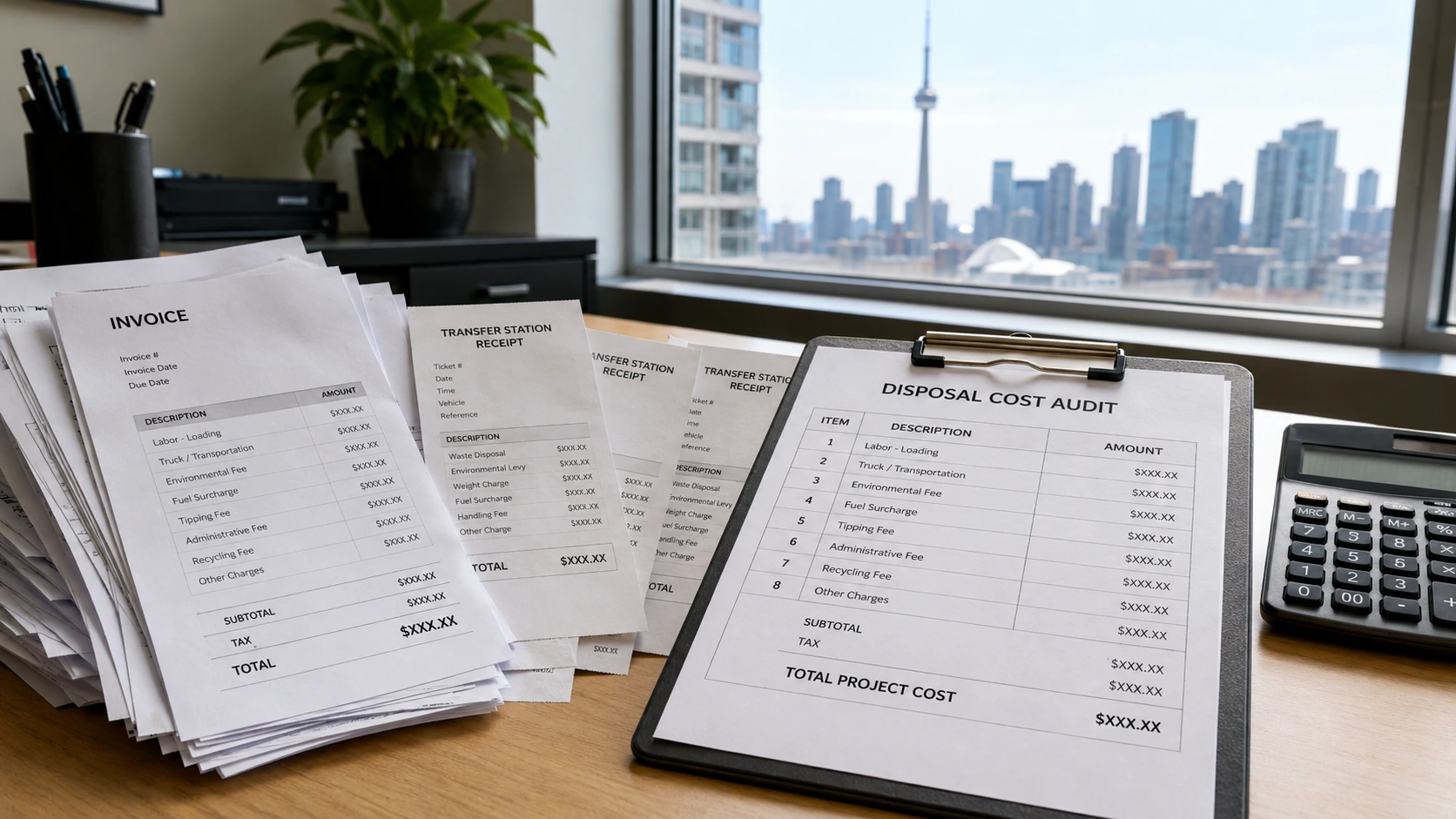
The headline price is not the final price. Across the disposal invoices generated by commercial decommissioning projects, five categories of cost commonly get added after the quote is signed:
- Materials excluded from standard waste streams. Electronics under provincial extended producer responsibility programs, drywall in several municipalities, mattresses in some Atlantic provinces, and other regulated materials carry separate handling fees that vendors pass through, often without itemization.
- After-hours and weekend premiums. Many commercial lease handbacks require after-hours work to avoid disrupting neighbouring tenants. Rush and after-hours work commonly carry a premium on the base labour rate.
- Freight elevator scheduling. Buildings that charge for elevator use, particularly for after-hours operations, pass that cost through to the tenant or the vendor, who in turn bills it on the disposal invoice.
- Building protection requirements. Some commercial buildings require padding, plywood, or other protection on elevators and corridors during a major removal. The cost is usually billed to the tenant.
- Re-mobilization fees. Projects that exceed the original scope often trigger re-mobilization charges if a second pickup day is needed. Vendors quote the initial scope; the second mobilization runs separately.
The cumulative effect of these surcharges is that the final disposal invoice is reliably higher than the quote, and the gap is hardest to predict on the projects where the vendor has the least incentive to disclose it upfront. Asking for a written list of every category of surcharge that could be billed after the quote is the strongest move a buyer can make before signing.
The Opportunity Cost: What You Lose to Recovery
The largest cost in a disposal-only engagement is usually not on the invoice. It is the recovery value that is not captured.
A typical commercial office contains a mix of mid-tier and premium brand furniture, much of which carries meaningful resale value through secondary-market channels. Used office furniture buyers, including dealers, smaller offices, schools, and non-profits, operate active purchasing networks. National refurbisher pricing data shows used Herman Miller Aerons commonly resell at $350 to $850 each depending on configuration. Other premium and mid-tier task chairs, sit-stand desks, conference room furniture, and modular workstations also retain resale value in conditions that vary by brand, age, and visible wear.
A disposal vendor does not run this process. They are not in the resale business; their economics are built around per-load disposal. The result is that everything in the truck, including assets that would have recovered four-figure or five-figure value, becomes part of the disposal stream.
On most mid-size and larger commercial offices, the comparison between a disposal-only engagement and a liquidation engagement favours liquidation once recovery value is factored in. The exact dollar comparison depends on the asset mix and the runway available before the deadline.
When Disposal Still Makes Sense
Disposal is the right answer in a narrow set of cases:
- Small inventories of low-grade or generic furniture
- Inventory old enough that resale demand is limited
- Heavily damaged or contaminated furniture (water, smoke, biological)
- Extreme deadlines where mobilization speed outweighs recovery
- Sites with no nearby secondary market
In every other scenario, the disposal cost is only one part of the question, and the comparison against liquidation usually favours the recovery path.
How to Evaluate a Disposal Quote
Five questions separate transparent disposal quotes from opaque ones.
- Is the headline price all-in, or are surcharges billed separately? Ask for a written list of every category of cost that could be added after the quote is signed.
- What is the unit rate on tipping fees, and is it passed through at cost or marked up?
- What is the labour rate, and does it cover dismantling, disassembly, and reinstatement, or only haul-away?
- What does the transfer-station receipt look like, and will it be provided as part of the project documentation?
- What is the policy if the scope expands? Is re-mobilization charged separately, and at what rate?
A vendor that cannot answer these questions directly is not transparent about their cost structure. A vendor that can answer them is at least running a documented operation, even if their final invoice ends up higher than the headline.
How Michael's Global Trading Audits Disposal Costs
Michael's Global Trading offers a disposal cost audit as part of the project walkthrough on any commercial decommissioning. The audit produces an itemized estimate of disposal-only cost across the three core line items and the typical surcharges, alongside an estimate of recovery value available through the office furniture liquidation path. The output is a side-by-side comparison so the decision-maker can see what a disposal-first engagement would cost against what a liquidation-first engagement would net.
Our work covers Toronto and the GTA, Ottawa, Montreal, and businesses across Canada. Where disposal is the right answer for the project (small inventory, aged stock, damaged material), we say so and run the project through our eco-friendly office furniture disposal channel with documentation. Where liquidation is the better answer, the audit makes the case explicit.
Frequently asked questions about office furniture disposal costs
Are landfill tipping fees the same across Canada?
No. Tipping fees vary by municipality, with most major Canadian urban regions sitting in broadly comparable bands and rural transfer stations differing more widely. Local transfer-station policies also differ on which materials are accepted at standard rates versus requiring separate handling fees.
Why are disposal vendors not transparent about surcharges?
The economic model of generic junk removal is built around per-load pricing with surcharges added at invoicing. The model competes on the headline number, not on the total. Transparent line-item pricing is the exception, not the rule, which is why asking for a written list of possible surcharges before signing is the strongest move a buyer can make.
What happens to the documentation a disposal vendor produces?
Typically the deliverable is an invoice and possibly a transfer-station receipt. There is no inventory reconciliation, no per-stream breakdown, no diversion percentage. For businesses that need audit-grade documentation, this gap is the largest non-financial cost of a disposal-only engagement.
Can I negotiate a disposal quote?
Yes, particularly on labour and transport. Tipping fees are pass-through and not generally negotiable. Volume helps: a larger project typically has more pricing flexibility than a small one. Asking for a line-item quote in advance is the strongest move on the buyer side.
How does disposal compare to liquidation on cost?
On most mid-size and larger commercial offices, the comparison favours liquidation once recovery value is factored in. The detailed breakdown is in our office furniture liquidation vs. disposal cost analysis.
Ready to See What Disposal Actually Costs on Your Project
Disposal vendors quote the haul. The real cost includes the surcharges, the documentation gap, and the recovery value left on the floor. Michael's Global Trading provides a free disposal cost audit on any commercial decommissioning, with an itemized estimate of disposal-only cost alongside the recovery available through liquidation. Contact us to walk your space and get an honest line-item breakdown before you sign a quote.
Recommended readings
Office Furniture Liquidation vs. Disposal: A Cost Comparison for Canadian Businesses
The Hidden Costs of Delaying Office Furniture Removal Before Lease Expiry
Recommended readings:

Blogs & News

Get started on
your journey with us.