
Strategic Asset Management: When to Repair, Liquidate, or Scrap
Compare repair, liquidation, and scrapping for aging business assets, considering condition, resale demand, timing, removal costs, and documentation.
Every organization eventually faces the same challenge: assets age, operations evolve, and what once supported growth can quietly become a drag on performance and cash flow. The strategic question isn’t simply what to do with surplus or aging assets, but when to repair them, pursue commercial asset liquidation, or scrap them altogether. Making the right decision at the right time protects value, reduces risk, and aligns your physical footprint with today’s business realities.
- Asset decisions directly affect operating costs, risk exposure, and sustainability
- Timing and execution matter as much as the option you choose
Understanding the Asset Lifecycle
Assets typically move through three stages: productive use, declining efficiency, and end-of-life. Problems arise when companies treat all aging assets the same. Some items still make financial sense to repair, others hold resale value through commercial asset liquidation, and some should be removed from circulation entirely.
According to the U.S. Department of Energy, poorly maintained or outdated equipment can consume significantly more energy than modern alternatives, quietly inflating operating costs over time (Energy.gov). Strategic asset management is about recognizing these inflection points early.
- Not all “old” assets are bad assets
- Lifecycle awareness prevents unnecessary spending
When Repair Is the Right Call
Repair makes sense when an asset still supports core operations and the fix meaningfully extends its useful life. This is common with high-quality machinery, premium office furniture, or specialized equipment where replacement lead times are long or capital budgets are constrained.
A common rule of thumb in facilities management is that if repair costs stay below 30–40% of replacement value, repair is often justified. Repairs also make sense when downtime costs would outweigh the price of maintenance.
- Repair assets that are essential and structurally sound
- Use repair to buy time when replacement is not immediately feasible
When Commercial Asset Liquidation Delivers More Value
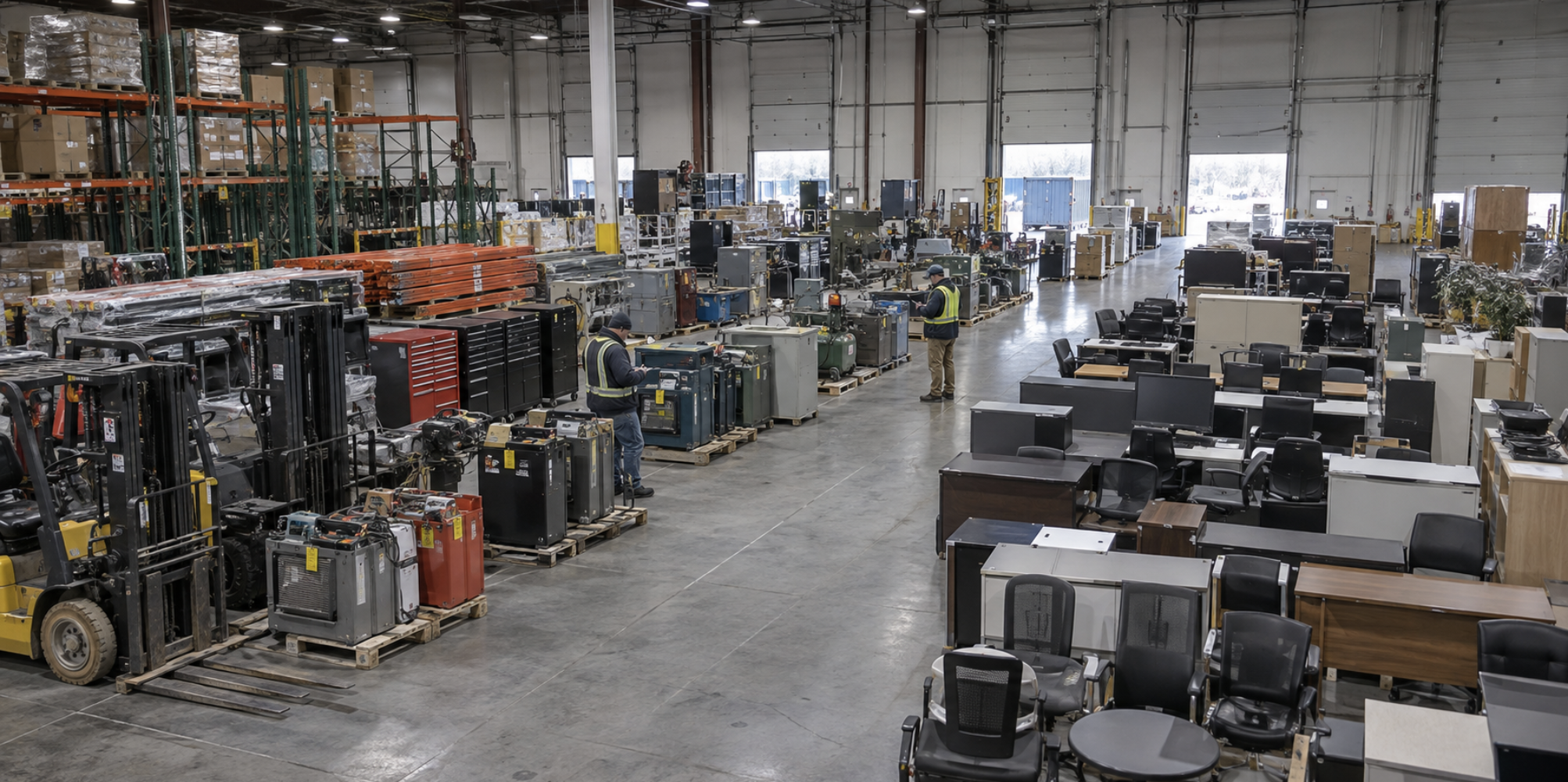
Liquidation is ideal when assets are still functional but no longer fit your business model. Examples include surplus furniture after downsizing, equipment replaced by automation, or assets left behind during a transition to remote or hybrid work. In these cases, commercial asset liquidation converts idle items into recovered capital while clearing space and reducing carrying costs.
Research from the National Bureau of Economic Research (NBER) shows that companies recover, on average, about 44% of book value for inventory and roughly 35% for property, plant, and equipment during liquidation events (NBER Working Paper 27642). That recovery can materially offset upgrade, relocation, or exit costs.
This is where working with an experienced partner, such as Michael’s Global Trading, adds value. A professional liquidator understands market demand, buyer channels, and timing—often achieving better net recovery than ad hoc sales or internal efforts.
- Liquidate assets that no longer align with operations but still have demand
- Commercial asset liquidation can fund upgrades or reduce exit expenses

When Scrapping Is the Responsible Option
Scrapping is the right decision when assets are unsafe, obsolete, non-compliant, or too damaged to repair or resell. Holding onto these items increases risk and often costs more in storage, insurance, and liability than their residual value.
From a sustainability standpoint, scrapping should still be done responsibly. The U.S. Environmental Protection Agency (EPA) reports that furniture and furnishings generated about 12.1 million tons of waste in 2018, with roughly 80% ending up in landfills (EPA Furniture & Furnishings Data). Certified recycling and material recovery reduce environmental impact and support ESG commitments.
- Scrap when safety, compliance, or reliability is compromised
- Use certified recyclers to minimize environmental and reputational risk
The Cost of Waiting Too Long
One of the biggest mistakes organizations make is delaying asset decisions. As assets sit unused, they depreciate further, markets shift, and resale demand shrinks. Storage and handling costs quietly accumulate, and the range of viable options narrows.
Early action preserves flexibility: you can still choose repair, pursue commercial asset liquidation, or plan a responsible scrap program. Late action often forces the least favorable option.
- Delays reduce recovery value and increase hidden costs
- Early decisions preserve leverage and choice
Data Security, Compliance, and Documentation
For IT assets, controls, and data-bearing equipment, end-of-life decisions must include secure data handling. Beyond data, documentation matters for every asset type. Inventories, condition notes, photos, bills of lading, and recycling certificates support audits, lease handbacks, insurance claims, and ESG reporting.
- Secure data handling protects brand and regulatory posture
- Clean documentation accelerates close-outs and reduces disputes
Why Execution Matters as Much as Strategy
Deciding whether to repair, liquidate, or scrap is only half the equation. Execution determines outcomes. Coordinating valuation, removal, logistics, resale, and recycling across multiple vendors often leads to delays and missed value.
This is why organizations partner with specialists like Michael’s Global Trading, who manage the entire disposition process end-to-end. Their integrated approach ensures assets are routed to the best outcome; repair, commercial asset liquidation, or scrap, while minimizing disruption to ongoing operations.
- One partner reduces complexity, vendors, and timelines
- Integrated execution improves recovery and lowers risk

Quick Recap
- Repair when assets are essential and repair costs are well below replacement
- Commercial asset liquidation when assets are surplus but still marketable
- Scrap when safety, compliance, or economics rule out other options
- Act early to preserve value and optionality
- Use credible standards (NBER, EPA, NIST) to guide decisions
- Partnering with experts like Michael’s Global Trading streamlines outcomes
Turn Asset Decisions Into a Competitive Advantage
Asset end-of-life doesn’t have to be reactive or wasteful. With a clear framework and disciplined execution, you can make informed decisions about when to repair, pursue commercial asset liquidation, or scrap. The result is cleaner facilities, stronger balance sheets, and a smoother transition to whatever comes next. Strategic asset management turns what could be a cost center into a measurable advantage.
Recommended readings:

Blogs & News


.jpg)
Get started on
your journey with us.