
Decommissioning vs. Liquidation vs. Removal: The Path to Vacant Office Furniture
Understand the difference between office furniture decommissioning, liquidation, and removal. Learn which approach fits your timeline, lease obligations, and asset value, and how the right strategy helps businesses vacate office space efficiently while reducing waste and recovering value.
When an office is closing, relocating, or downsizing, the terms “removal,” “liquidation,” and “decommissioning” are often used interchangeably. In reality, they represent very different approaches with very different outcomes. Choosing the wrong path can lead to missed lease deadlines, lost asset value, and unnecessary stress. Understanding how these options differ helps you select the most efficient route to a fully vacant, compliant space.
- Each approach serves a different business objective
- The right choice depends on timelines, lease terms, and asset value
What Office Furniture Decommissioning Actually Means
Office furniture decommissioning is a comprehensive, planned process that goes far beyond hauling furniture out the door. It includes pre-project planning, coordination with building management, phased disassembly, asset routing, and final documentation to confirm the space meets lease handback requirements. This is why office furniture decommissioning is typically used for large offices, multi-floor spaces, or enterprise exits.
- Designed for predictable, lease-compliant closeouts
- Focuses on planning, sequencing, and documentation
How Liquidation Fits Into an Office Exit
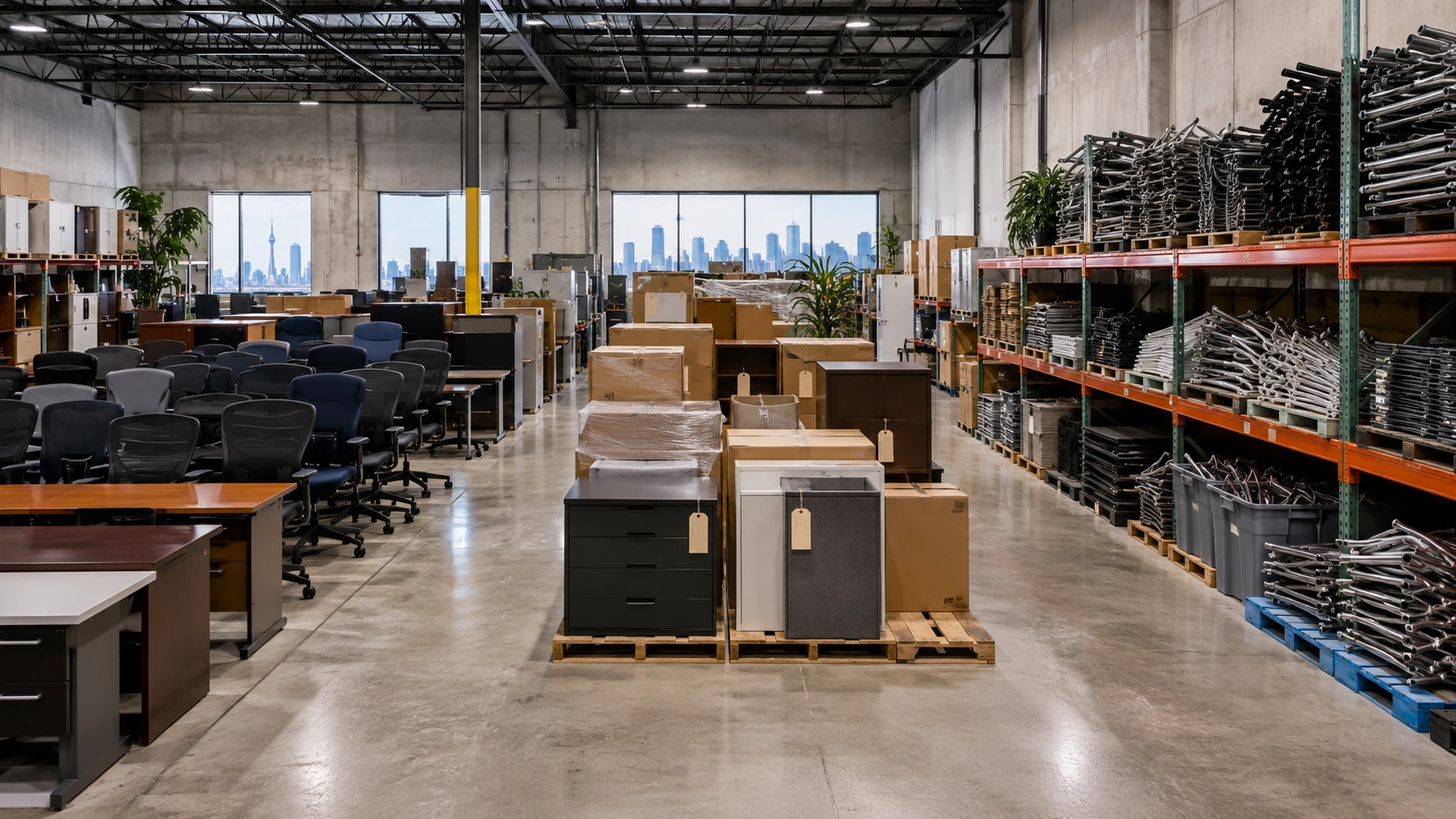
Liquidation is about value recovery. Desks, chairs, storage units, and boardroom furniture that are no longer needed can often be resold rather than discarded. Liquidation works best when it is embedded within a structured decommissioning plan, ensuring assets are evaluated and removed in the right order. When coordinated properly, liquidation offsets project costs and reduces waste. National office vacancy in Canada has reached 18–20% in major markets, reflecting sustained downsizing and consolidation as hybrid work becomes permanent. (CBRE Canada)
- Converts surplus furniture into recovered capital
- Prevents usable assets from being prematurely disposed of
What Removal Means and When It Works
Removal is the simplest option and usually refers to physical hauling and disposal. It can be appropriate for damaged, obsolete, or low-value items. However, removal alone does not address lease compliance, asset recovery, or sustainability goals. In larger projects, relying only on removal often leads to missed opportunities and rushed decisions.
- Best suited for small cleanouts or non-recoverable items
- Limited scope with little focus on compliance or reporting

Why Timing and Sequencing Matter
One of the most common mistakes in office exits is acting too quickly. Removing furniture before liquidation assessments or without a decommissioning plan often results in lost value and rework. A structured timeline ensures valuable assets are identified first, removed second, and disposed of last. From a financial perspective, timing matters. Studies show organizations recover 35–45% of book value through structured liquidation, compared to minimal recovery when assets are removed or scrapped without a plan. (NBER)
- Early planning preserves resale and donation opportunities
- Proper sequencing avoids unnecessary costs and delays
Lease Obligations and Documentation
Many office leases require proof that furniture, cabling, and fixtures have been removed and that the space has been restored to a specific condition. Decommissioning provides the documentation landlords expect, while liquidation and removal alone usually do not. This is a key reason companies turn to office furniture decommissioning instead of piecemeal services.
- Documentation protects security deposits and avoids disputes
- Confirms the space is truly move-out ready
The Role of a Single Coordinated Partner
Managing multiple vendors for liquidation, removal, and compliance often creates gaps and delays. A coordinated partner like Michael’s Global Trading brings these services together under one plan, reducing handoffs and confusion. With experience across complex office exits, Michael’s helps ensure that decommissioning, liquidation, and removal work together instead of competing with each other.
- One partner simplifies communication and accountability
- Integrated services lead to faster, cleaner project completion

The Most Efficient Path to Vacant Office Furniture
For most businesses, the most effective approach combines all three methods. Decommissioning sets the structure and timeline, liquidation recovers value from usable assets, and removal clears the remaining materials. This layered strategy delivers better financial and operational results than relying on any single method alone.
- Combining approaches reduces waste and maximizes recovery
- A structured plan prevents last-minute scrambling
Quick Recap
- Decommissioning is a planned, lease-aligned process that ensures full closeout
- Liquidation focuses on resale and value recovery
- Removal handles hauling and disposal of low-value items
- Timing and sequencing are critical to success
- Office furniture decommissioning provides the structure that makes liquidation and removal effective
- Partners like Michael’s Global Trading help coordinate complex office exits
Choose Structure Over Shortcuts
Vacant office furniture is not just a cleanup task, it is a project that impacts deadlines, budgets, and compliance. While removal and liquidation have their place, office furniture decommissioning provides the framework that ensures everything is done in the right order and documented properly. When handled with the right strategy and partner, the path to a vacant office becomes predictable, efficient, and far less stressful.
Recommended readings:

Blogs & News



Get started on
your journey with us.