
How Hybrid Work Is Creating a Commercial Furniture Surplus Crisis in Canada
Hybrid work has created a Canadian commercial furniture surplus unlike anything in 20 years. The data, where the surplus is going, and what businesses should do.
How Hybrid Work Is Creating a Commercial Furniture Surplus Crisis in Canada
The shift to hybrid work has produced something Canadian commercial real estate has not seen in two decades: a structural office furniture surplus across every major market. Tenants are right-sizing, landlords are recovering space, and the physical inventory coming off floors is moving faster than the secondary market can absorb. The downstream effect is a furniture problem most businesses did not plan for.
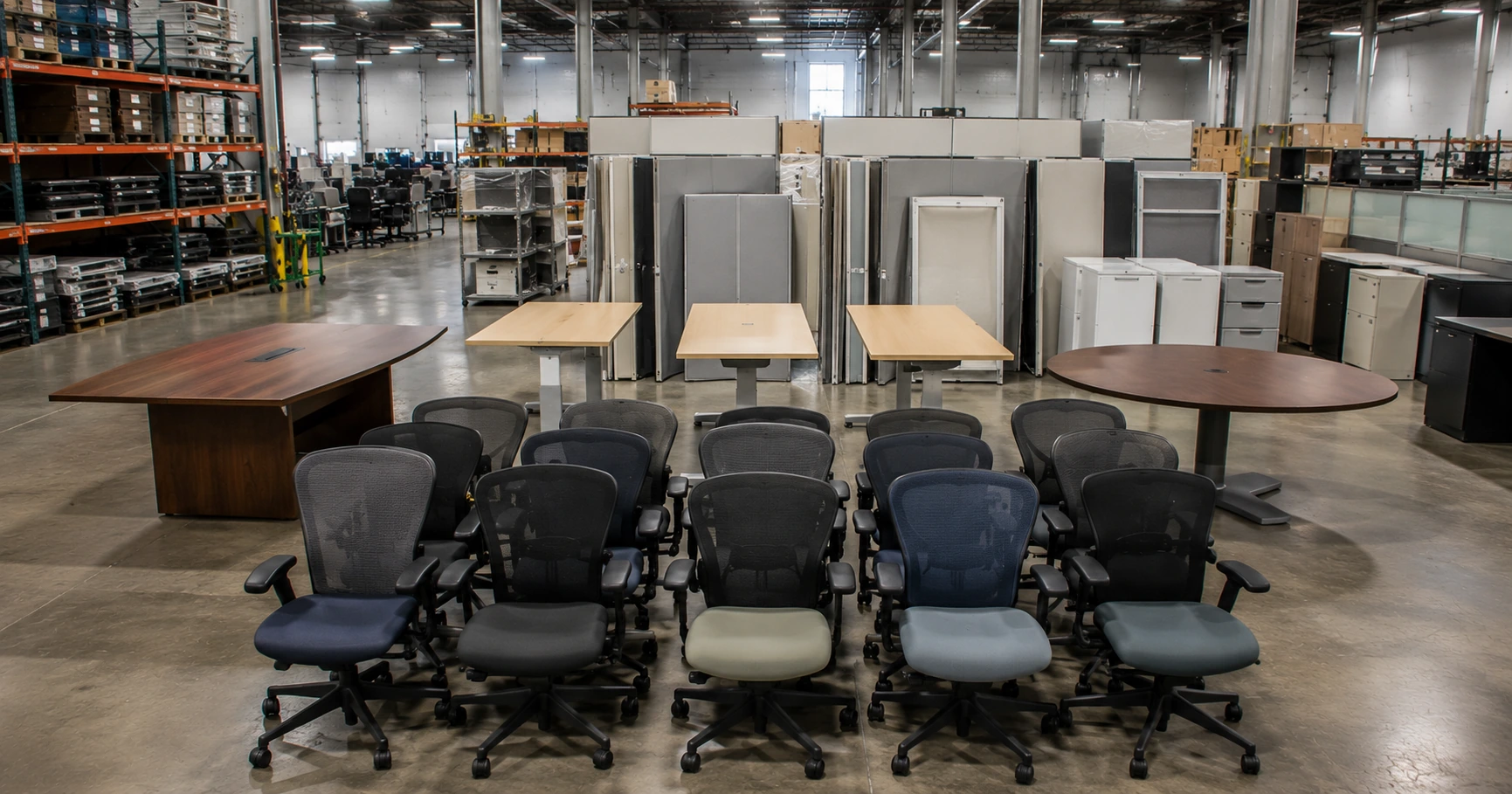
The Shift, in Numbers
Canadian office vacancy has been declining for several consecutive quarters, but the underlying composition of returned space tells the real story. CBRE Canada's Q4 2025 Office Figures report 3.2 million sq ft of sublease space came off the national market in 2025, the most in any single year since 2005, with sublease inventory ending the year at 11.4 million sq ft (on par with 2017 levels). Toronto led the pull-back, with downtown overall vacancy decreasing 160 basis points to 15.0% in Q4 2025 and Class A and AAA vacancy falling 450 basis points over the year.
What looks like a recovery in the vacancy data is, in operational terms, a wave of tenants giving back space they no longer need. Leases signed before 2022 are rolling into renewal at the same time companies are formalizing hybrid policies. Hybrid tenants have reduced their office-space demand meaningfully: office-density benchmarks indicate companies with employees coming in roughly once a week have cut office space demand by around 40% between 2019 and 2025. The decisions get made in conference rooms in Q3. The physical work hits loading docks in Q4 and Q1 of the following year.
The business turnover layer compounds it. Statistics Canada's monthly business openings and closures release for December 2025 showed the monthly closure rate at 4.8%, above the historical average of 4.6%, with the rate remaining above the historical average throughout 2025. Every closure involving a leased commercial space sends a furniture inventory back into the secondary market or onto a disposal truck.
Why Furniture Is the Downstream Effect
Office space contraction does not produce itself. Every reduction (a floor consolidation, a downsize, a closure of a regional office) creates physical inventory the tenant has to move, store, sell, donate, or dispose of inside the lease-end clock. Workstations, task chairs, sit-stand desks, modular partitions, conference furniture, kitchen fit-outs, and the supporting IT equipment all have to leave the space before the landlord takes it back.
Multiply the per-tenant volume across the 3.2 million sq ft of Canadian sublease returns reported by CBRE in 2025 alone, and the implied furniture volume runs into hundreds of thousands of pieces of usable inventory hitting the market in a compressed window. The secondary market is real and active, but it does not absorb that volume at the speed it is being produced. The result is downward pressure on resale value, longer sales cycles for tenants who try to handle it themselves, and a growing share of recoverable furniture ending up in landfill because the timeline did not permit anything else.
Where the Surplus Is Actually Going

A well-handled surplus moves through four streams in descending order:
- Resale into the secondary market captures the highest value.
- Donation routes to registered charities and generates CRA receipts.
- Recycling captures material value (steel, aluminum, engineered wood) and counts toward landfill diversion.
- Landfill is the failure case.
The current pattern in Canada is heavily weighted toward the last two, not because that is what businesses want, but because they engage the question too late.
Resale into the secondary market captures the highest value, and it is the most time-sensitive. Used office furniture buyers (dealers, smaller offices, schools, and non-profits) buy on a defined cadence, and a tenant with adequate runway can capture a meaningful share of original retail value on premium brands. Industry depreciation benchmarks indicate commercial office furniture retains roughly 30 to 40% of value after 5 years, with brand, age, and condition driving most of the variance.
Donation routes through Canada's network of furniture-focused charities: Habitat for Humanity ReStores across most provinces, the Furniture Bank network with chapters in Toronto, Edmonton, and Halifax, HomeStart Foundation in Vancouver, Renaissance Quebec in Montreal, and Mennonite Central Committee thrift operations on the Prairies. Donation generates CRA charitable receipts at fair market value, which offset taxable income.
Recycling captures material value (steel from chair frames, aluminum from desk components, MDF and particle board from cabinetry) and counts toward landfill diversion metrics. Landfill is the failure case. U.S. EPA data shows furniture and furnishings make up roughly 12 million tons of U.S. municipal solid waste annually, with about 80% landfilled. Comparable Canadian aggregate data is less granular but reflects broadly similar disposal patterns.
The Reverse-Logistics Problem Most Businesses Did Not Plan For
Companies that grew during the office expansion years of 2015 to 2019 built procurement processes for buying furniture. Almost none of them built a process for moving large volumes of furniture back out. The skill set, the vendor network, and the documentation infrastructure for commercial asset liquidation sit outside the typical facilities team's playbook.
The recurring pattern in 2025 and 2026 right-sizings looks like this: a facilities manager is given short notice that the company is consolidating floors. The manager reaches out to a junk-removal vendor. The vendor quotes disposal of the entire inventory without a recovery line. The CFO sees the bill, asks why nothing was recovered, and a project that should have netted the business meaningful resale value generates an avoidable expense instead.
The reverse-logistics gap is also where compliance risk lives. Some categories of office equipment (data-bearing devices, electronics under provincial EPR programs, fixtures with refrigerants) carry handling obligations that generic junk-removal vendors are not licensed to manage. The volume coming back to market in this surplus wave is forcing the question into the open at companies that previously did not need to think about it.
How Right-Sizing Is Reshaping Office Layouts
The hybrid surplus is not random. It follows the structural change in how Canadian offices are being designed for 2026 and beyond. Three patterns dominate the current wave of right-sizings:
- Assigned workstations are giving way to hot-desking and reservation-based seating. Companies are running fewer desks for the same headcount, with the difference becoming surplus inventory.
- Meeting rooms are being consolidated into smaller, higher-quality spaces. Standard meeting rooms are being removed and replaced with fewer well-equipped collaboration spaces. The shed inventory includes conference tables, mid-tier chairs, and AV equipment that often has refurbishment value.
- Dedicated executive offices are being deleted. Hybrid policies have made fixed executive footprints harder to justify, and the high-end furniture in those spaces (often the most expensive single-room inventory in the building) is moving into the surplus stream.
The asset profile of the current surplus is, on average, younger and higher-quality than what came off the market in pre-pandemic decommissioning waves. The implication for businesses is that recovery value is higher per unit if engaged early, and the cost of disposing of usable inventory is correspondingly larger.
The Sustainability Dimension
The surplus has an ESG dimension that has become a board-level concern at larger Canadian businesses. Companies reporting under SASB, GRI 306 (Waste, 2020), or CDP frameworks must disclose waste-to-landfill numbers, and a major facilities event that sends a large share of office furniture to landfill is a material disclosure event for many of them. Capital markets are increasingly asking the questions, and the answer "we used a junk-removal vendor" creates a documentation gap that auditors flag.
Landfill diversion is the metric that captures the alternative. A liquidation engagement that routes through resale, donation, and certified recycling diverts a substantial share of project tonnage from landfill, and the landfill diversion reporting most liquidators provide is the documentation that goes into the ESG disclosure. For companies with diversion targets, the surplus crisis is also an opportunity to demonstrate measurable performance against those targets.
How Michael's Global Trading Is Helping Canadian Businesses Manage the Surplus
Michael's Global Trading has been running commercial liquidation and decommissioning projects in Canada since 2013, and the volume mix of our work has shifted substantially since 2024 as the hybrid surplus has come online. Where previously the average project was a single-tenant move-out, the current pipeline is heavily weighted toward floor consolidations, regional office closures, and full-floor decommissioning under tight lease-end deadlines.
The operational model our team applies to these projects produces a written estimate with disposal cost and recovery broken out separately, so the business sees the gross expense and the resale upside before any work begins.
Our work covers Toronto and the GTA, Ottawa, Montreal, and businesses across Canada. Scope spans office furniture, IT and ITAD, warehouse, and industrial assets under a single point of contact, with chain-of-custody documentation, certified e-waste recycling for IT in the mix, and landfill diversion reporting for sustainability teams.
Frequently asked questions about the Canadian furniture surplus
How large is the current Canadian office furniture surplus, in practical terms?
The 3.2 million sq ft of sublease space that came off the Canadian market in 2025 alone (per CBRE Canada) implies hundreds of thousands of pieces of usable furniture moving through the surplus stream. The volume is concentrated in Toronto, Vancouver, Calgary, and Montreal.
Is the surplus driving down resale values?
Yes, modestly. Premium brands still command strong recovery on usable units, but mid-tier inventory has compressed in price as supply outpaces demand in the 2025-2026 window. The compression is most visible on standard task chairs and entry-level workstations.
Should businesses hold furniture in storage until the market improves?
Generally no. Industry depreciation benchmarks place commercial furniture loss at 10 to 20% annually in active use, with stored inventory closer to the lower end of that range. Storage costs are also significant. The recovery window is now, and waiting typically erodes more value than it captures.
What is the alternative to selling or donating?
Certified recycling for materials that have no resale or donation pathway. Steel, aluminum, and engineered wood components recover material value when processed through R2-aligned recyclers, and the diversion counts toward ESG reporting.
Will the surplus continue into 2027?
The current wave of lease rolls supporting hybrid right-sizings runs through at least mid-2027 based on commercial lease rollover patterns reported by major Canadian brokerages. The volume should moderate after that, but the structural shift to lower square-footage-per-employee is permanent.
Quick Recap
- Sublease wave is real: 3.2 million sq ft came off the Canadian market in 2025, the most in two decades.
- Furniture is the downstream artifact: Every right-sizing or closure produces physical inventory the tenant has to move on the lease clock.
- Four streams in order: Resale, donation, recycling, landfill. The current mix is too weighted to the last two.
- Reverse-logistics gap is the operational problem: Most businesses built buying processes, not return processes.
- ESG dimension is material: Diversion reporting is now a board-level conversation at larger Canadian businesses.
Ready to Get Ahead of Your Surplus
The hybrid-work furniture surplus is not a temporary blip. It is a structural shift in how Canadian businesses use commercial space, and the inventory implications will run through the next 18 months. Michael's Global Trading provides commercial asset liquidation to businesses across Toronto, the GTA, Ottawa, Montreal, and the rest of Canada. Contact us to book a free assessment of your surplus and a written estimate of what recovery looks like before the deadline arrives.
Recommended readings
Office Furniture Liquidation vs. Disposal: A Cost Comparison for Canadian Businesses
Impact of Remote Work on Office Liquidation
Recommended readings:

Blogs & News

Get started on
your journey with us.