
E-Waste Compliance in Canada: What Businesses Must Know Before Disposing of Electronics
A Canadian business guide to e-waste compliance: federal and provincial rules, EPR programs, PIPEDA obligations, audit trails, and penalties for getting it wrong.
E-Waste Compliance in Canada: What Businesses Must Know Before Disposing of Electronics
Disposing of electronics in Canada is not a logistics problem. It is a regulatory problem with a logistics layer. Federal data-protection law, provincial extended producer responsibility (EPR) programs, and industry-specific reporting standards all apply when a business retires IT equipment. Getting it wrong creates exposure across data, environment, and finance at the same time.
What "E-Waste" Actually Means in Canadian Regulation
The term covers more than computers. Each provincial EPR program publishes a list of regulated electronics, and the categories generally include display devices (monitors, televisions), computers and peripherals (laptops, desktops, keyboards, mice), servers and networking equipment, printers, copiers and imaging equipment, telephony (desk phones, cell phones, fax machines), and audio and video equipment.
Items outside these categories such as small appliances, batteries, and household goods are usually covered under separate stewardship programs (for example Call2Recycle for batteries). The provincial program's regulated list defines what counts as compliance-bound e-waste for the business retiring it, and it varies by province. Items outside the program are still subject to general waste regulations.
The EPR Framework: Who Is Responsible for What
Canadian e-waste is governed under an extended producer responsibility (EPR) model. Producers (the manufacturers and importers) fund the recycling infrastructure through environmental handling fees added at the point of sale. Provincial regulators set the rules. Approved processors do the work.
For a Canadian business retiring electronics, the practical obligation is to route the equipment through an approved processor or program. The business is not the producer, but it is responsible for the chain of custody from its loading dock to the regulated processor. Documentation of that chain proves compliance later, and it is the artifact regulators and auditors actually request.
Provincial Programs
Each province operates its own program under the national umbrella of Recycle My Electronics, administered by the Electronic Products Recycling Association (EPRA).
In Ontario, the program is administered by the Resource Productivity and Recovery Authority (RPRA) under the Electrical and Electronic Equipment regulation, scoped to information technology, telecommunications, and audio-visual (ITT/AV) equipment. Businesses must route e-waste to RPRA-registered processors. Approved processors appear on RPRA's public registry, and producers must ensure at least 65% of ITT/AV supplied is processed, refurbished, or reused for the 2025-2029 performance periods.
In Quebec, ARPE-Québec runs the program. Registered processors handle the regulated categories. Reporting requirements apply to large producers; routing requirements apply to all businesses.
In British Columbia, Encorp Pacific operates Recycle My Electronics with drop-off and pickup programs. In Alberta, the Alberta Recycling Management Authority (ARMA) oversees the program; a surcharge applies at the point of new-equipment sale, and processing is provided through approved facilities. In Saskatchewan, Manitoba, and Atlantic Canada, programs operate through EPRA chapters in each province with regional approved processors.
For multi-province businesses, a national vendor with cross-provincial approvals simplifies compliance considerably, and every program publishes its processor registry so the right route can be confirmed before any disposal vendor is signed.
PIPEDA and Data Security Obligations

Provincial e-waste programs cover the physical disposal. The federal Personal Information Protection and Electronic Documents Act (PIPEDA) covers what is on the disposed equipment.
PIPEDA holds organizations accountable for personal information from collection through destruction. Principle 4.7.5 of PIPEDA, as set out in the Office of the Privacy Commissioner's safeguards guidance, requires that personal information be destroyed using methods that prevent unauthorized parties from gaining access. A laptop sent to a recycler with the hard drive still readable is a breach event under PIPEDA, regardless of whether the recycler is provincially approved for the physical disposal.
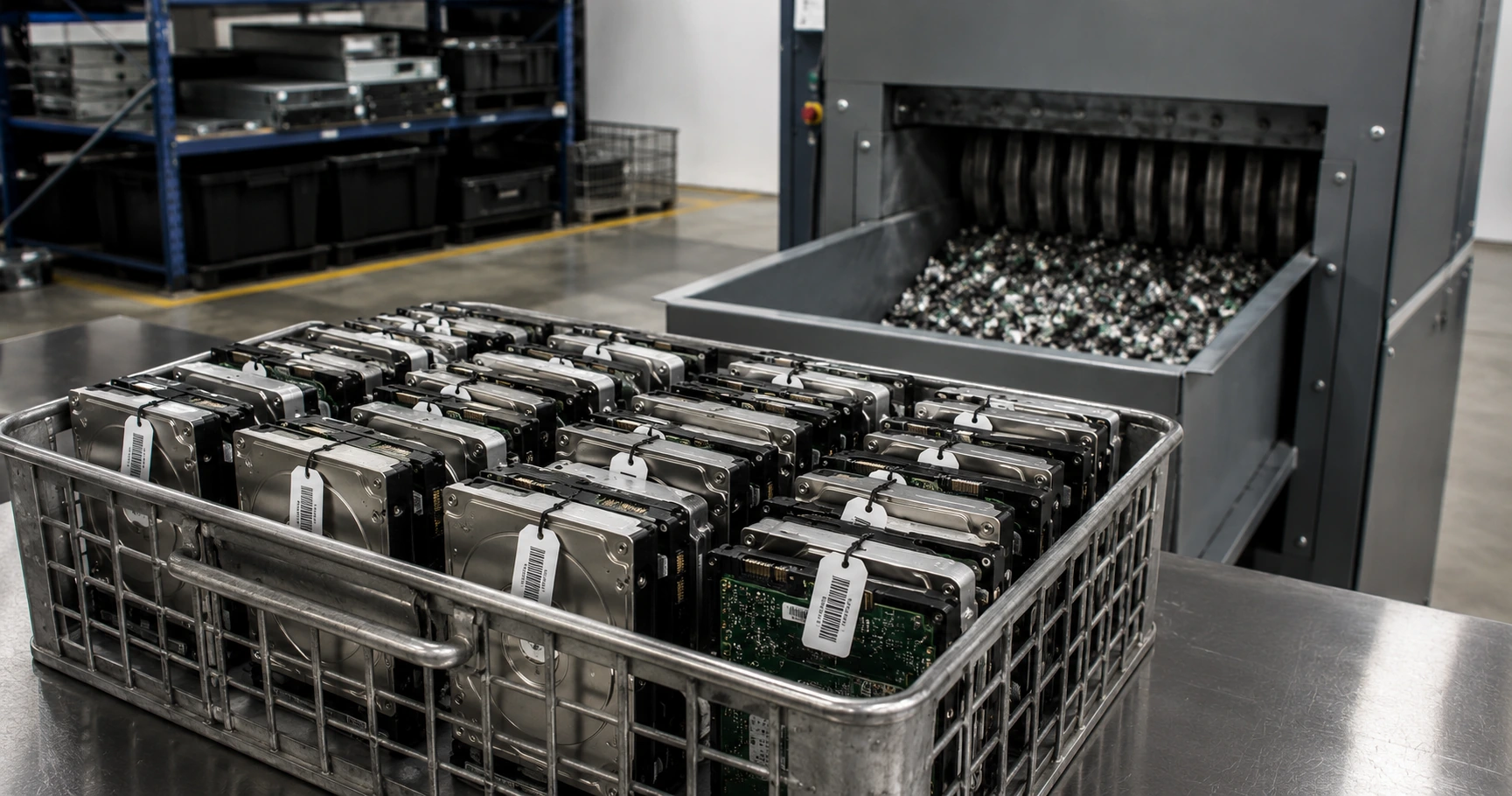
In practice, this requires certified data destruction following NIST Special Publication 800-88 Revision 2 guidelines for media sanitization before equipment leaves the building, or chain-of-custody data destruction performed at the processor's secure facility with Certificates of Destruction returned to the business. This is the work category covered by IT asset disposition.
The financial stakes are real. IBM's 2024 Cost of a Data Breach Report places the average breach cost in Canada at CA$6.32 million. Equipment-disposal-originated breaches are among the most preventable categories on that list. Physical recycling and data destruction are separate compliance obligations, and a processor receipt is not a Certificate of Destruction.
Penalties for Non-Compliance
The financial exposure has three sources. Administrative penalties under the Resource Recovery and Circular Economy Act, 2016 can reach $1 million per contravention, and provincial offence prosecution adds fines of up to $250,000 per day for a corporation's first offence and $500,000 per day for subsequent offences. PIPEDA exposure adds federal weight: data breaches resulting from improperly disposed equipment trigger mandatory breach reporting to the Office of the Privacy Commissioner of Canada and affected individuals, plus remediation cost, legal exposure, and reputational damage. Specific PIPEDA offences (obstructing an investigation, destroying records subject to a complaint, retaliation against whistleblowers) carry fines up to $100,000 on indictable conviction. Civil and class-action exposure is separate and not capped by the offence schedule.
The third source is contractual. Many B2B contracts and supply-chain compliance frameworks (SOC 2, ISO 27001, vendor security questionnaires) require documented certified disposal. Failure to produce documentation can void contracts or trigger audit findings, and in practice the contractual layer is often the largest exposure.
The Audit Trail Every Business Should Maintain
A compliant disposal generates documentation at four points:
- Inventory: Asset list with serial numbers, models, and condition at the point of pickup.
- Chain of custody: Signed transfer document at every handoff (loading dock to truck, truck to processor).
- Data destruction certificate: Confirms NIST 800-88 method, devices destroyed, and operator credentials.
- Final disposition report: Shows what was resold, refurbished, recycled, and disposed, with weights or unit counts per stream.
Audit-ready businesses retain this documentation for at least 6 years to align with the CRA's general record-keeping requirement and align it with internal asset registers. The documentation should reconcile to the inventory: every serial number in, every serial number accounted for out. The strategic framing of when to retire IT assets is covered in our IT asset lifecycle management guide. A processor that does not produce these documents on request is not a compliance vendor.
How to Build a Compliant Disposal Process
The five steps below describe a process that satisfies provincial EPR programs, PIPEDA, and most contractual requirements.
- Verify the vendor: check provincial processor registries (RPRA, ARPE-Québec, Encorp, ARMA) and confirm R2 (Responsible Recycling) or RIOS certification for the recycling component.
- Inventory before pickup: capture serial numbers, models, condition, and data-bearing status for each asset.
- Separate data-bearing assets: equipment with storage (laptops, desktops, servers, copiers with hard drives, networked devices) follows the certified data destruction path. Non-data-bearing equipment follows the standard recycling path.
- Document the chain of custody: signed transfers at every handoff, with timestamps and operator names.
- Collect and retain documentation: Certificates of Destruction, processor receipts, final disposition report, filed and accessible for the retention period set by CRA and any sector-specific rules.
Most Canadian liquidators with ITAD capabilities run this process by default. Generalist disposal vendors typically do not, and the gap is where compliance fails. Our checklist for securely disposing of IT assets covers the operational details for an internal team, and the right vendor selection criterion is the certifications they hold, not the price they quote.
How Michael's Global Trading Handles E-Waste Compliance
Michael's Global Trading runs IT asset disposition to NIST 800-88 standards with on-site or facility-based data destruction, R2-aligned recycling partners, and full chain-of-custody documentation. The final disposition report shows what was refurbished and resold, what was recycled, what was destroyed, and where each stream went.
We hold approvals to operate through provincial programs in Ontario, Quebec, and across Canada through EPRA-affiliated channels. Our e-waste recycling services cover Toronto and the GTA, Ottawa, Montreal, and businesses operating across multiple provinces under a single point of contact. The deliverables (Certificates of Destruction, audit packages, reporting) are built for SOC 2, ISO 27001, and customer-supplier compliance reviews.
Frequently asked questions about e-waste compliance in Canada
Is e-waste regulation federal or provincial in Canada?
Both. Provincial EPR programs cover physical disposal of regulated electronics. Federal PIPEDA covers personal information on those electronics. A compliant process satisfies both.
What is the difference between R2, RIOS, and e-Stewards?
Three industry certifications for recycling operations. R2 (Responsible Recycling) and e-Stewards are the two main standards in North America; RIOS is an environmental management system standard often paired with R2. All three require documented downstream tracking and data destruction protocols.
Does our business need a Certificate of Destruction for every device?
For data-bearing devices, yes. The certificate is what proves PIPEDA compliance in a breach investigation or audit. Non-data-bearing devices (printers without hard drives, monitors, keyboards, mice) require chain-of-custody documentation but not a Certificate of Destruction.
Can we dispose of e-waste through municipal waste programs?
No. Regulated e-waste is excluded from municipal solid waste streams in every Canadian province. Disposal through municipal channels is a provincial violation and creates federal data-protection exposure if any device was data-bearing.
How long should we retain disposal documentation?
At least 6 years to align with the CRA's general record-keeping requirement. Some industries (financial services, healthcare) have longer retention obligations under sector-specific regulation.
What if our IT department has been disposing of equipment informally for years?
A retrospective audit and a forward-looking process are the two priorities. The retrospective audit identifies any data-bearing devices that may have left without certified destruction, a potential PIPEDA breach reporting trigger. The forward-looking process puts the five steps above in place for everything from this point on.
Quick Recap
- Provincial framework: Programs administered through EPRA, RPRA, ARPE-Québec, Encorp, and ARMA.
- Federal layer: PIPEDA requires certified destruction of data-bearing devices.
- Three penalty layers: Provincial environmental fines (up to $1M per contravention), federal data-protection exposure, contractual breaches.
- Four-document audit trail: Inventory, chain of custody, data destruction certificate, final disposition report.
- Vendor selection criterion: Certifications (R2, RIOS, provincial approvals), not pricing.
Ready to Set Up a Compliant Disposition Process
E-waste compliance is straightforward when planned and expensive when reactive. Michael's Global Trading provides e-waste recycling services and certified IT asset disposition to businesses across Toronto, the GTA, Ottawa, Montreal, and the rest of Canada, under provincial approvals and to NIST 800-88 data destruction standards. Contact us to walk your inventory and set up a compliant disposition process before your next IT refresh.
Recommended readings
IT Asset Lifecycle Management: When to Liquidate, Donate, or Recycle Your Tech
Checklist for Securely Disposing of IT Assets
Recommended readings:


Blogs & News



Get started on
your journey with us.