
The Essential Warehouse Equipment Checklist
Just about everyone knows about supply and demand. Supply is what some people have, and demand is what other people want. It’s simple and easy to understand. But, let’s just say for the sake of argument that there are a few more nuances and particulars to cover to get a better vision the big picture.
The Essential Warehouse Equipment Checklist
A warehouse depends on more than available floor space. The right storage systems, material-handling equipment, loading dock infrastructure, conveyors, and facility accessories determine how efficiently inventory can move from receiving to storage and eventually back out for delivery.
The original warehouse equipment checklist from Michael's Global Trading breaks warehouse equipment into five core areas: storage, lifting, docks, conveyors, and accessories. Those categories remain a useful starting point because they cover the basic physical systems involved in storing and moving goods through a facility.
The exact equipment required will depend on the warehouse. A distributor handling palletized consumer goods has different requirements from a manufacturer moving heavy raw materials. Product dimensions, weight, turnover, storage height, order-picking methods, and shipping volume all influence what belongs on the equipment list.
Before buying new or used warehouse equipment, start with the operation itself. Understand what comes into the building, where it needs to go, how employees handle it, and how it eventually leaves.
The Basics of Warehouse Equipment
Warehouses sit between different stages of the supply chain. Manufacturers need space for raw materials and finished products. Distributors need inventory available for picking and shipping. Retail and e-commerce operations may depend on warehouses to keep thousands of products organized and ready for fulfilment.
Regardless of the business model, most warehouse equipment serves one of five purposes:
- Storage: Keeping materials and products organized and accessible.
- Lifting and material handling: Moving goods between locations and storage levels.
- Loading dock operations: Transferring goods between the warehouse and trucks.
- Conveying: Moving products efficiently through repeated routes.
- Facility support: Providing access, workspace, security, and additional usable space.
Layout, order picking, transportation, and the type of inventory being stored should influence every equipment decision.
For example, perishable products may require a storage system that supports inventory rotation. Long building materials may require cantilever racking instead of conventional pallet racks. A facility shipping hundreds of cartons per hour may benefit from conveyors, while a smaller warehouse may be able to operate efficiently using carts and pallet jacks.
The goal isn't to purchase as much equipment as possible. It is to choose equipment that supports the work without creating unnecessary congestion, maintenance, or capital expense.
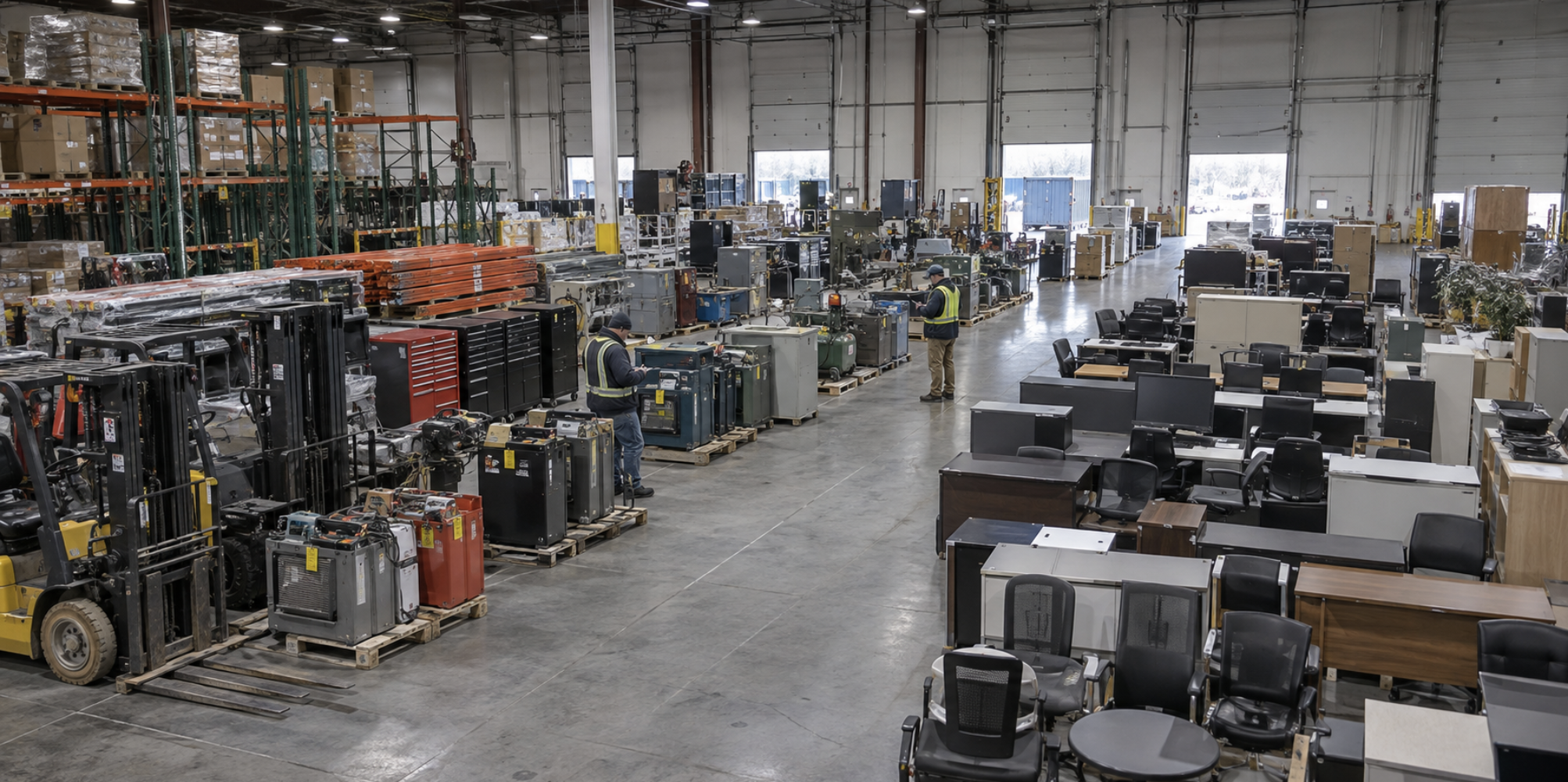
Warehouse equipment can also represent significant recoverable value when a facility closes, relocates, or changes its layout. MGT's warehouse liquidation services cover racking, shelving, forklifts, material-handling equipment, carts, workbenches, inventory, and other warehouse assets.
1. Warehouse Storage Equipment
Storage is one of the first systems to address because nearly every other warehouse activity depends on where inventory is kept.
Raw materials, finished products, spare parts, packaging, and other goods need to be stored in a way that makes them accessible without wasting available cubic space.
The right storage system depends on the size, weight, quantity, and movement of the inventory.
Pallet Racking
Pallet racking is one of the most common storage systems in warehouses that handle palletized products.
It allows inventory to be stored vertically rather than consuming large amounts of floor space. Depending on the warehouse design, different racking configurations can prioritize direct access, storage density, or product rotation.
Before purchasing pallet racking, determine:
- pallet dimensions
- typical and maximum load weights
- required storage height
- forklift or reach-truck access
- aisle dimensions
- ceiling and sprinkler clearances
- inventory turnover
- required rack configuration
The racking and the handling equipment need to work together. A rack layout that maximizes storage density but leaves insufficient room for the lift equipment used in the facility creates an operational problem rather than solving one.
Industrial Shelving
Not every product belongs on a pallet.
Industrial shelving is useful for smaller products, cartons, parts, tools, supplies, and inventory employees need to access manually.
Shelving can be particularly useful in picking areas where employees regularly retrieve individual units rather than complete pallets.
When planning industrial shelving, consider the weight of the products, shelf dimensions, picking height, accessibility, and how frequently each item is retrieved.
High-volume products are generally easier to manage when they are positioned in accessible locations rather than forcing employees to repeatedly reach or travel unnecessarily.
Cantilever Racking
Cantilever racks are designed for long or irregular materials that don't fit comfortably into standard pallet-racking bays.
Typical examples include:
- lumber
- pipes
- tubing
- steel sections
- building materials
- long manufactured components
The open-front structure allows long products to be loaded and removed without vertical columns obstructing access.
Businesses storing long materials should assess both load requirements and the handling equipment that will place those materials onto the rack.
Flow Racking
Flow racks are designed to move inventory through the rack rather than keeping each product in one fixed position.
Depending on the system, cartons or pallets are loaded from one side and move toward the picking side. This can support higher-volume operations and inventory-rotation requirements.
Flow systems can be useful when the same products move through the warehouse frequently and replenishment needs to remain separate from picking.
The additional complexity means the system should be justified by the actual product movement. A slower-moving warehouse may not need a specialized flow configuration when simpler shelving or pallet racking can perform the same job.
2. Lifting and Material-Handling Equipment
Warehouse products don't move themselves.
Once inventory is received, employees need equipment to unload it, move it through the building, place it into storage, retrieve it, and prepare it for shipment.
The right handling equipment depends heavily on the load.
The original MGT checklist highlights forklifts, pallet jacks, hand trucks, and service carts, all of which continue to perform distinct roles within warehouses.
Forklifts
Forklifts are essential in many facilities handling pallets, heavy goods, or elevated storage.
They may be used to:
- unload trucks
- transport pallets
- place inventory into racking
- retrieve elevated loads
- move raw materials
- stage outbound shipments
Choosing a forklift should involve more than asking how much weight it can lift.
Consider the required lift height, load dimensions, aisle width, operating environment, attachments, fuel or power source, and how frequently the equipment will be used.
A warehouse with tall racking and narrow aisles may need very different equipment from a manufacturing facility moving heavy materials across an open floor.
If a warehouse is closing or replacing its fleet, forklifts and other handling equipment should be included in the asset assessment. MGT identifies forklifts and material-handling equipment among the assets commonly handled through its warehouse liquidation services.
Pallet Jacks
Pallet jacks provide a simpler way to move palletized loads at floor level.
Manual pallet jacks can be useful for shorter movements and lighter-duty applications, while powered versions may make sense when loads are heavier, distances are longer, or pallet movement is frequent.
They don't replace forklifts where goods need to be placed on elevated racks, but they can reduce unnecessary forklift use for simple horizontal movement.
Hand Trucks and Service Carts
Smaller warehouses may rely heavily on hand trucks, platform carts, dollies, and service carts.
Even large distribution facilities use them for tasks that don't justify bringing in powered equipment.
Common applications include:
- moving cartons
- transporting supplies
- carrying tools
- transferring small orders
- moving irregular items
- supporting maintenance operations
The important point from the original checklist still applies: material-handling requirements change as the business changes.
A warehouse should leave room for changes in inventory size, order volume, product mix, and customer requirements rather than purchasing equipment that only works for one narrow operating condition.
3. Loading Dock Equipment
Storage gets a great deal of attention when planning a warehouse, but the loading dock is just as important.
Almost everything entering or leaving a conventional warehouse passes through receiving or shipping areas. If the dock can't handle those movements efficiently, problems quickly spread into the rest of the operation.
The original MGT guide highlights dock plates and boards, dock levellers, yard ramps, and hoppers as important pieces of dock and material-handling infrastructure.
Dock Plates and Dock Boards
Dock plates and boards bridge the gap between the loading dock and a truck or trailer.
The appropriate equipment depends on the loads and handling equipment crossing that gap.
A warehouse moving loaded forklifts has different requirements from one moving smaller loads with pallet jacks or hand trucks.
Capacity should always be matched to the equipment and load expected to cross the dock.
Dock Levellers
Truck and trailer heights can vary.
Dock levellers help create a more practical transition between the dock and vehicle when those surfaces do not align perfectly.
For warehouses handling regular truck traffic, that transition has a direct effect on how quickly goods can move through receiving and shipping.
Yard Ramps
Not every facility has a permanent loading dock in the right place for every task.
Yard ramps can provide access between ground level and truck or trailer height, making them useful for some facilities that need more flexible loading arrangements.
Before acquiring one, consider its capacity, working height, available yard space, surface conditions, and the equipment that will travel on it.
Dump Hoppers
Dump hoppers can support waste, scrap, packaging, manufacturing offcuts, and other material-handling needs.
They are particularly relevant in facilities where employees repeatedly collect bulk material and need a practical way to move or empty it.
As with any warehouse equipment, the hopper should be chosen around what it will contain and how it will be moved.
Don't Treat the Loading Dock as an Afterthought
The loading dock connects the warehouse with the outside transportation network.
A business can have excellent racking and material-handling equipment and still create bottlenecks if trucks can't be loaded or unloaded efficiently.
Review:
- typical vehicle types
- dock heights
- daily shipment volume
- staging requirements
- forklift traffic
- pedestrian routes
- loading and unloading procedures
- available yard space
The dock should be planned as part of the warehouse workflow, not separately from it.
4. Conveyor Systems
Some warehouses move products over the same routes hundreds or thousands of times.
At that point, repeatedly moving every carton manually may no longer make sense.
Conveyor systems can create a consistent route between receiving, storage, picking, packing, sorting, manufacturing, and shipping areas.
The original article identifies three common categories: flexible conveyors, gravity conveyors, and powered conveyors. It also includes lifts and carousels as related systems used to move or present inventory.
Gravity Conveyors
Gravity conveyors use rollers or wheels to move products without a powered drive system.
They can be useful where the layout and product allow gravity or manual force to move cartons through a predictable route.
Because there are fewer powered components, they can provide a relatively straightforward solution for certain receiving, packing, and shipping applications.
Powered Conveyors
Powered conveyors move products using motors, belts, powered rollers, or other drive systems.
They become useful when a warehouse needs a controlled and continuous material flow across longer distances or through higher-volume processes.
Potential applications include:
- order fulfilment
- packing lines
- sortation
- production areas
- receiving
- shipping
- movement between workstations
Before installing a powered conveyor, determine what needs to travel on it, how quickly goods need to move, and where employees need access to the system.
Flexible Conveyors
Flexible conveyors can extend, contract, and change direction to accommodate changing workflows.
They are often useful near shipping and receiving areas where the exact position of a trailer, workstation, or staging area may change.
The important distinction is flexibility. A system can help the warehouse adapt its route without committing every movement to a permanently fixed conveyor line.
Lifts and Carousels
Vertical lifts and storage carousels can help warehouses use vertical space or bring inventory closer to employees.
These systems are more specialized than basic racking and shelving, but they can be valuable when a facility has high inventory density, repetitive picking activity, or limited floor space.
They can also become significant assets during a facility closure. Businesses preparing to remove larger warehouse systems should consider evaluation before demolition or disposal. MGT's warehouse decommissioning services include the assessment and removal of racking, fixtures, equipment, and related warehouse infrastructure.
5. Warehouse Facility Accessories
The final category in the original checklist covers the supporting equipment that makes a warehouse easier to manage.
These items may not move thousands of products per hour, but they support storage, administration, security, maintenance, and access throughout the facility.
Warehouse Office Space
Warehouses still need areas for administrative work.
Shipping documents, inventory records, payroll, scheduling, management, and other office functions often need a cleaner and quieter environment than the main warehouse floor.
Depending on the facility, businesses may create enclosed warehouse offices or dedicated administrative spaces within the larger building.
The location should make sense operationally. Supervisors may need visibility or quick access to the floor, while administrative staff may need separation from dust, equipment noise, and warehouse traffic.
Mezzanines
A mezzanine can add another usable level within a warehouse and help take advantage of vertical building space.
Businesses may use mezzanines for:
- storage
- offices
- light work areas
- parts
- supplies
- other operational functions
The application needs to be planned around the structure and intended loads.
When an existing warehouse is being closed or reconfigured, mezzanine systems may also become part of the outgoing asset inventory. Before assuming a structure has no remaining value, include it in the facility assessment.
Rolling Ladders
Rolling ladders provide access to elevated shelves and storage areas where powered equipment is unnecessary or impractical.
Choose ladder height around the actual picking and access requirements rather than simply purchasing the tallest unit available.
The warehouse also needs enough room to position and store the ladder without obstructing aisles or equipment traffic.
Security Cages
Some inventory, tools, equipment, or supplies need controlled access.
Security cages can create a separate area within the warehouse without requiring a completely enclosed room.
They may be useful for:
- valuable inventory
- tools
- controlled materials
- maintenance equipment
- electronics
- restricted stock
The cage should support the actual security requirement while still fitting within warehouse traffic and storage plans.
Workbenches, Carts, Bins, and Other Support Equipment
Smaller support assets can be easy to overlook because they aren't as expensive as forklifts or racking systems.
However, a functioning warehouse may depend on:
- workbenches
- storage bins
- rolling carts
- packing stations
- parts cabinets
- lockers
- warehouse office furniture
- maintenance equipment
These items should be included when planning a warehouse from the beginning and when inventorying a warehouse for liquidation at the end.
MGT currently identifies rolling carts, ladders, workbenches, warehouse office furniture, fixtures, packaging supplies, racking, shelving, and handling equipment among the assets commonly encountered during warehouse liquidation.
Match the Equipment to the Warehouse Workflow
An equipment checklist becomes useful only when it is connected to how the warehouse actually operates.
Start at receiving and follow a typical product through the building.
Ask:
- How does the product arrive? Palletized, loose, containerized, or in cartons?
- How is it unloaded? Forklift, pallet jack, conveyor, or manual handling?
- Where is it stored? Pallet rack, shelving, cantilever rack, flow rack, or another system?
- How is it retrieved? Full pallet, case, individual unit, or raw material?
- Where does picking or processing happen?
- How does it reach packing or shipping?
- How does it leave the building?
That exercise makes equipment gaps easier to identify.
It can also expose unnecessary equipment.
A warehouse should not install a conveyor because conveyors are associated with large distribution centres. It should install one when the repeated material flow makes a conveyor a practical improvement.
The same principle applies to racking, forklifts, mezzanines, and every other item on the checklist.
Buying New vs. Used Warehouse Equipment
Not every warehouse needs brand-new equipment.
Used warehouse equipment can be worth considering when the specifications, condition, and remaining useful life fit the operation. Racking, shelving, workbenches, carts, material-handling equipment, and other commercial assets regularly move through the secondary market as businesses relocate, restructure, or close facilities.
Before purchasing used equipment, confirm:
- manufacturer and model where applicable
- dimensions
- rated capacity
- age
- condition
- maintenance history where relevant
- missing or damaged components
- disassembly requirements
- transportation cost
- installation requirements
- compatibility with the intended warehouse
Do not let a low purchase price override suitability.
Equipment that needs expensive repairs, cannot fit the facility, or doesn't meet the required capacity can quickly become more expensive than an appropriate alternative.
Buying Warehouse Equipment at Auction
The original MGT article specifically points to warehouse auctions as a place where businesses may acquire equipment.
Auctions can provide access to racking, shelving, forklifts, carts, workbenches, and other assets being released by businesses that are closing or restructuring.
Before bidding, know the maximum amount the equipment is worth to your operation.
The purchase calculation should include more than the winning bid. Depending on the sale, the buyer may also need to arrange dismantling, loading, transportation, repairs, and installation.
Inspect equipment when the opportunity is available and make sure you understand exactly what is included in the lot.
A warehouse rack consisting of beams without the required uprights or hardware is not equivalent to a complete usable system. The same applies to conveyors missing controls or powered equipment requiring substantial repair.
What Happens to Warehouse Equipment When a Facility Closes?
The same equipment needed to build a warehouse becomes an asset-recovery opportunity when that warehouse is closed, downsized, or relocated.
Businesses should inventory the equipment before beginning the cleanout.
That can include:
- pallet racking
- industrial shelving
- forklifts
- pallet jacks
- conveyors
- workbenches
- carts
- ladders
- security cages
- office furniture
- inventory
- packaging materials
MGT's warehouse liquidation services begin with a review of the warehouse layout, asset list, and project deadline. Assets are then evaluated for resale potential and removal complexity before the liquidation plan is developed.
If the project involves removing infrastructure as well as selling assets, warehouse decommissioning can also include equipment disconnection, racking teardown, fixture removal, cleanout, and final turnover of the facility.
Assessing those assets before clearing them gives the business an opportunity to recover value rather than automatically treating every piece of equipment as a disposal cost.
Frequently Asked Questions About Warehouse Equipment
What equipment does every warehouse need?
There is no universal equipment list for every warehouse. Most facilities need some combination of storage, material-handling equipment, loading infrastructure, and facility support equipment, but the exact setup depends on inventory, volume, storage height, picking methods, and transportation requirements.
What are the main types of warehouse storage equipment?
Common systems include pallet racking, industrial shelving, cantilever racks, and flow racks. The correct option depends on the dimensions, weight, quantity, and turnover of the products being stored.
What material-handling equipment is commonly used in warehouses?
Forklifts, pallet jacks, hand trucks, platform carts, and service carts are common examples. Larger or more specialized facilities may require additional lift equipment depending on their loads and storage systems.
When does a warehouse need conveyors?
Conveyors become worth assessing when materials repeatedly move through the same route or process. Gravity, powered, and flexible conveyors serve different purposes depending on the products, distance, volume, and layout.
Can used warehouse equipment be purchased?
Yes. Racking, shelving, material-handling equipment, workbenches, conveyors, carts, and other warehouse assets are regularly sold through the secondary market. Condition, capacity, completeness, compatibility, dismantling, transport, and installation should all be assessed before purchasing.
Can warehouse equipment be liquidated when a business closes?
Yes. MGT's warehouse liquidation service covers racking, shelving, forklifts, material-handling equipment, carts, workbenches, inventory, and other warehouse assets. Whether an individual asset has resale value depends on its condition, configuration, demand, and the project circumstances.
Should warehouse equipment be dismantled before it is assessed for liquidation?
Generally, have it assessed first. Keeping racking, conveyors, mezzanines, and other systems intact during the initial review can make it easier to understand their configuration and condition before a dismantling plan is developed.
Quick Recap
- Storage equipment: Pallet racking, industrial shelving, cantilever racks, and flow racks organize inventory and make better use of warehouse space.
- Lifting equipment: Forklifts, pallet jacks, hand trucks, and carts move products between receiving, storage, picking, and shipping.
- Loading dock equipment: Dock plates, boards, levellers, yard ramps, and other equipment support the transfer between vehicles and the warehouse.
- Conveyors: Gravity, powered, and flexible conveyor systems can improve repeated product movement through larger or higher-volume facilities.
- Facility accessories: Mezzanines, rolling ladders, security cages, offices, workbenches, and storage accessories support the broader operation.
- Match equipment to the workflow: The right warehouse setup depends on what is stored, how it moves, and how frequently it is handled.
- Assess outgoing assets before disposal: Racking, equipment, inventory, and other warehouse assets may have recoverable value when a facility closes or restructures.
Clearing or Reconfiguring a Warehouse?
Warehouse equipment represents a substantial investment, and it should be assessed before being treated as part of a general cleanout.
Michael's Global Trading provides warehouse liquidation services across Toronto and Canada for businesses closing, relocating, downsizing, or restructuring warehouse facilities. MGT evaluates racking, shelving, forklifts, material-handling equipment, inventory, and other warehouse assets, then develops a plan around resale potential, removal requirements, and the project deadline.
For facilities requiring a complete strip-out, MGT also provides warehouse decommissioning services, including racking teardown, equipment removal, fixture removal, cleanout, and final turnover.
Send us photographs or an equipment inventory, your location, and the date the warehouse needs to be cleared. We'll assess the assets and determine the most practical liquidation and removal approach.
Recommended Readings
Types of Warehouse Equipment That Can Be Liquidated
Why You Should Hire a Professional Warehouse Liquidator
Recommended readings:

Blogs & News
Get started on
your journey with us.