
How To Approach The Sale Of Liquidated Assets
An asset can be considered almost anything, but it’s usually something of value such as a property. When you are downsizing or file bankruptcy, assets must be sold off (liquidated).
How to Approach the Sale of Liquidated Assets
When a business downsizes, closes a location, replaces equipment, or ends up with excess inventory, the assets it no longer needs can often be converted back into working capital through liquidation.
Those assets might include machinery, office furniture, warehouse equipment, retail fixtures, electronics, inventory, or other commercial property with remaining market value. The challenge is determining how to sell them without allowing the process to become expensive, time-consuming, or disruptive.
Two of the most common approaches are a whole-lot purchase, where an agreed group of assets is sold to one buyer or a small group of buyers, and an auction, where assets are marketed to bidders and sold through a competitive process.
Neither method is automatically better. The right approach depends on the type of assets, their condition and demand, how quickly they need to leave, and how much work the business wants to manage internally.
Professional commercial asset liquidation can help businesses evaluate those factors before committing to a sales method.
What Does It Mean to Liquidate Business Assets?
Asset liquidation is the process of converting business property into cash by selling assets the company no longer needs.
Businesses may liquidate assets because they are:
- closing completely
- downsizing
- relocating
- consolidating locations
- upgrading equipment
- clearing excess inventory
- discontinuing a product line
- restructuring operations
- freeing warehouse or office space
A business does not need to be bankrupt or shutting down to liquidate assets.
A growing company may liquidate older equipment after an upgrade. A retailer may sell excess inventory to free warehouse capacity. A company moving into a smaller office may sell hundreds of desks and chairs that will not fit into the new location.
The common factor is that an asset that once served the business has become surplus.
Before deciding how to sell it, determine exactly what is available and whether there is a secondary market for it.
Start With an Accurate Asset Inventory
Before approaching buyers, auctions, or liquidators, establish what is actually being sold.
A useful inventory should include:
- asset description
- quantity
- manufacturer and model where applicable
- approximate age
- condition
- photographs
- serial numbers for significant equipment
- location within the facility
- whether the asset is currently operating
- earliest available removal date
For larger liquidation projects, grouping similar assets can make the inventory easier to evaluate. Instead of listing 150 identical chairs individually, for example, they may be documented as one lot with photographs and condition notes.
Significant machinery and specialized equipment should generally receive more detail.
MGT's commercial liquidation process similarly begins with an asset inventory and assessment before determining how the assets should be marketed and removed.
That initial work provides the foundation for deciding whether a whole-lot sale, auction, or another approach makes the most sense.
Understand What the Assets Are Worth
The original purchase price is rarely a useful liquidation price.
Equipment depreciates. Furniture styles change. Technology becomes outdated. Inventory demand changes. Some assets retain substantial secondary-market value, while others may have little value despite having originally been expensive.
Condition, age, quantity, configuration, brand, location, buyer demand, and the amount of time available to sell can all influence recovery.
A good valuation should therefore answer a practical question:
What is this asset realistically worth under the conditions of this sale?
That can be different from what it might achieve if the business had unlimited time to find the perfect buyer.
The selling method can also affect the result. A buyer purchasing an entire inventory at once is taking on different risks and costs from a buyer purchasing one carefully selected asset.
Once the inventory has been evaluated, the business can begin comparing the two approaches discussed in the original article.
Whole-Lot Purchase
A whole-lot purchase involves selling an agreed group of assets in one transaction rather than selling every item individually.
For businesses with substantial surplus inventory or equipment, this can simplify the liquidation considerably.
Instead of finding buyers for hundreds or thousands of separate assets, the seller negotiates with a buyer willing to acquire a significant portion, or potentially all, of the available inventory.
This approach can be particularly useful during:
- warehouse closures
- retail liquidations
- office downsizings
- manufacturing facility closures
- large inventory clearances
- equipment upgrades
- relocations with hard deadlines
Why Businesses Consider Whole-Lot Sales
The main advantage is simplicity.
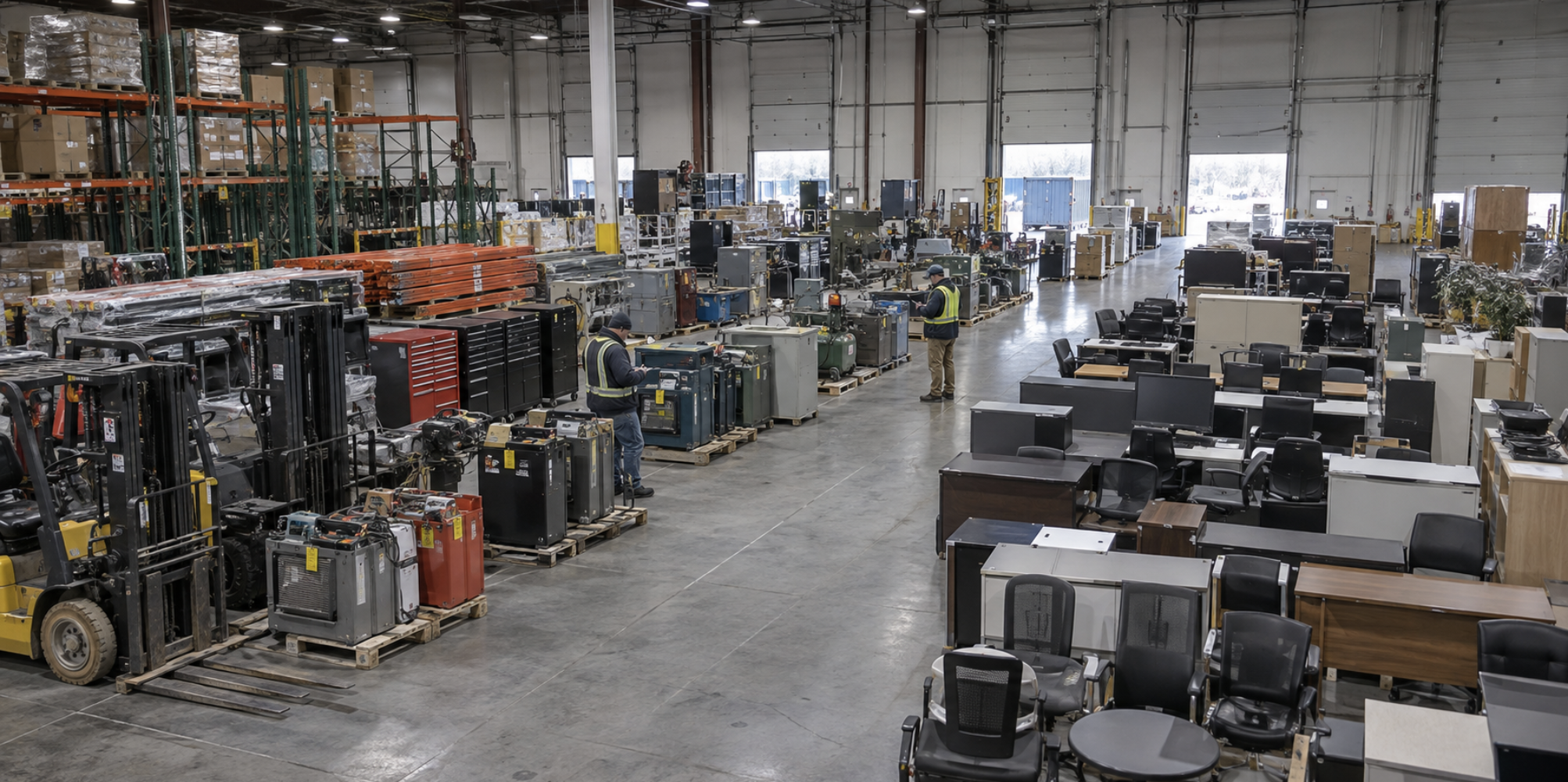
Imagine a warehouse containing 500 shelving sections, several forklifts, workbenches, pallet jacks, office furniture, and surplus inventory.
Selling every item separately might theoretically produce more gross revenue. It could also require dozens of listings, inspections, negotiations, invoices, collections, and transportation arrangements.
A whole-lot buyer reduces the number of transactions.
That can create value even when the per-item selling price is lower.
How Whole-Lot Buyers Evaluate Assets
A buyer purchasing a large group of assets needs enough room in the transaction to cover the costs and risks associated with reselling them.
Those considerations may include:
- transportation
- dismantling
- storage
- sorting
- testing
- repairs
- advertising
- packaging
- administration
- resale time
- assets that may ultimately remain unsold
This is why the value of an entire lot should not necessarily be calculated by adding together the highest possible retail resale price of every individual item.
The buyer is purchasing both the assets and the work involved in turning those assets into future sales.
For the seller, the tradeoff is usually between higher potential individual selling prices and a faster, more consolidated transaction.
Negotiating a Whole-Lot Purchase
Negotiation plays an important role in a whole-lot sale.
Before accepting an offer, make sure both parties are evaluating the same inventory.
A written agreement should clearly identify:
- which assets are included
- which assets are excluded
- the total purchase price
- payment timing
- removal dates
- who handles dismantling
- who provides labour
- who loads the assets
- who arranges transportation
- what happens if an item shown on the inventory is missing or substantially different in condition
Those details can materially change the economics of the offer.
For example, a $30,000 offer that includes complete dismantling and removal may produce a better outcome than a $35,000 offer that leaves the seller responsible for several thousand dollars of labour and transportation.
This is why liquidation should be evaluated using the net result, not only the purchase price.
MGT's guide to commercial liquidation costs in Canada follows the same principle by separating the gross cost of a project from the asset recovery that can offset it.
Auction
An auction takes a different approach.
Instead of negotiating directly with one buyer for the entire inventory, assets are marketed to potential buyers who compete through bidding.
Depending on the project, equipment may be sold individually or grouped into lots.
An auction can be useful when:
- there are several potential buyers for the assets
- establishing a single negotiated price is difficult
- the inventory contains a wide variety of equipment
- individual assets have meaningful standalone value
- competitive bidding may help establish the market price
- the business has enough time to prepare and market the sale
Online auctions can also allow buyers from a broader geographic market to participate without attending the facility in person.
How an Asset Auction Works
The exact process varies, but a commercial equipment auction usually begins with the same preparation required for another liquidation method.
The assets need to be identified, photographed, described, and divided into sensible lots.
A listing might include:
- photographs
- manufacturer
- model
- quantity
- condition
- known operating status
- included accessories
- inspection information
- pickup location
- collection deadline
Buyers then bid according to the rules of the sale.
Once bidding closes, successful buyers complete payment and arrange collection according to the auction terms.
For a business selling an entire facility, that last stage deserves careful planning.
Having 40 successful buyers can generate competition for the assets, but it can also mean coordinating 40 different collections.
The sale method and the removal plan should therefore be considered together.
Do Auctions Always Produce a Higher Return?
No.
An auction creates the opportunity for competitive bidding, but it does not guarantee that multiple motivated buyers will compete for every asset.
Some equipment may receive significant interest. Other items may attract one bidder or no bidders at all.
The result can depend on:
- buyer demand
- equipment condition
- how well the sale is marketed
- the quality of the listings
- inspection opportunities
- reserve prices
- timing
- location
- collection requirements
Businesses should also account for any seller-side costs associated with preparing or conducting the auction.
Compare the expected net proceeds with the alternatives rather than assuming competitive bidding automatically produces the strongest result.
Whole-Lot Purchase vs. Auction
The original article compares whole-lot purchases and auctions as the two primary approaches to liquidating business assets. The choice becomes easier when the business considers what it needs most from the transaction.
Choose a Whole-Lot Purchase When Simplicity Matters
A whole-lot sale may be particularly attractive when the business wants:
- fewer buyers to manage
- a defined purchase price
- one coordinated removal
- a quicker decision
- less internal administration
- a buyer willing to take a substantial portion of the inventory
It can also make sense when clearing the entire facility matters more than obtaining the maximum possible price for every individual item.
Consider an Auction When Competitive Bidding Matters
An auction may be appropriate when:
- individual assets have substantial value
- there is an established buyer market
- the inventory can be divided into attractive lots
- the business has time to prepare the sale
- reaching multiple buyers could improve price discovery
An auction can also be useful where the seller does not know exactly what buyers will be willing to pay and wants the market to establish the result.
Do Not Choose Based on Speed Alone
The original article characterized auctions as the faster option, but that depends on the circumstances.
A whole-lot purchase can sometimes be completed very quickly when a buyer is ready to purchase and remove the inventory.
An auction may require time for photography, cataloguing, marketing, inspection, bidding, payment, and collection.
For another project, the opposite may be true.
The useful comparison is the complete timeline from inventory assessment to final removal, not simply how quickly a selling price can be established.
Consider What Happens to the Assets That Do Not Sell
One of the most important liquidation questions is often overlooked:
What happens to everything that remains?
An auction may successfully sell the most desirable equipment while leaving lower-value assets behind.
A whole-lot buyer may exclude certain categories from the offer.
The business still needs a plan for those items.
Depending on the assets, remaining inventory may be:
- offered to another buyer
- grouped into a secondary lot
- donated
- recycled
- disposed of
This becomes especially important when the liquidation is connected to a lease expiry or facility closure.
The project is not complete when the valuable equipment sells. It is complete when the required assets are gone and the premises are ready for the next stage.
Market Your Liquidated Assets Properly
Regardless of the selling method, potential buyers need enough information to decide whether the assets are worth pursuing.
High-quality photographs and accurate descriptions help buyers understand what they are considering.
For significant equipment, provide information such as:
- make and model
- age
- operating condition
- capacity
- dimensions
- accessories
- maintenance information where available
- known defects
- removal requirements
Avoid vague descriptions such as “good condition” when more precise information can be provided.
For a deeper look at this side of the process, MGT's guide to creating a marketing strategy for liquidated assets covers how businesses can position available assets for prospective buyers.
Better information does not guarantee a sale, but it reduces uncertainty for serious buyers.
Factor Removal Into the Sale From the Beginning
An asset's sale price is only part of a commercial liquidation.
Large equipment may require:
- professional disconnection
- dismantling
- rigging
- forklifts or lifting equipment
- freight elevators
- loading docks
- trailers
- specialized transportation
Office furniture may require workstations and cubicles to be dismantled before collection.
Warehouse racking may need to be unanchored and broken down into transportable components.
The seller should determine whether these responsibilities belong to the buyer or remain with the business before accepting the transaction.
MGT's commercial asset liquidation services combine asset evaluation with disassembly, removal, transport, resale, and final routing where required, allowing the financial and physical sides of the project to be planned together.
Know When to Bring in a Professional Liquidator
Smaller asset sales can sometimes be managed internally.
A business selling several desks or one piece of surplus equipment may be able to photograph the assets, find a buyer, and arrange collection without outside support.
The calculation changes when the business is dealing with:
- large inventories
- multiple asset categories
- specialized equipment
- several floors or locations
- difficult building access
- short lease deadlines
- substantial dismantling requirements
- numerous potential buyers
- inventory that needs several different disposition routes
At that point, liquidation becomes a project rather than a simple sale.
A professional liquidator can assess the inventory, determine which assets have resale potential, reach buyers, coordinate transactions, and connect the sale with the physical clearance.
Frequently Asked Questions About Selling Liquidated Assets
What is a whole-lot purchase?
A whole-lot purchase is the negotiated sale of a defined group of assets to one buyer or a limited number of buyers. Rather than selling every item separately, the seller agrees on a price for a larger portion of the available inventory.
Is selling assets in bulk always less profitable?
Not necessarily. Individual sales may achieve higher prices for certain assets, but they can also create additional advertising, storage, labour, transaction, and collection costs. Compare the net outcome rather than only the individual selling prices.
Are auctions always faster than negotiated sales?
No. The timeline depends on the inventory and sale process. Auctions may require cataloguing, marketing, bidding, payment, and multiple collections. A whole-lot purchase can sometimes be completed faster when a suitable buyer is already available.
Which assets are suitable for liquidation?
Commercial furniture, machinery, warehouse equipment, electronics, retail fixtures, inventory, and other business assets may all have resale potential. Condition, age, quantity, configuration, and buyer demand determine whether a particular asset is attractive to the secondary market.
Should business equipment be appraised before liquidation?
Significant or specialized equipment can benefit from an informed valuation before offers are accepted. An assessment provides a better basis for comparing negotiated offers, bulk purchases, and auction outcomes.
Can several liquidation methods be used in the same project?
Yes. A business might sell valuable machinery individually, move a large group of standard equipment through a whole-lot purchase, and use another route for the remaining assets. The liquidation method can be selected by asset category rather than applying one approach to everything.
What happens if some assets do not sell?
Create a fallback plan before the final clearance deadline. Depending on the assets, unsold items may be remarketed, donated, recycled, or disposed of. A complete liquidation plan should account for the full inventory.
Quick Recap
- Start with an inventory: Know exactly what is available, its condition, and when it can leave.
- Understand realistic value: Original purchase price does not determine current liquidation value.
- Whole-lot purchases simplify the sale: One buyer can reduce the number of transactions, collections, and negotiations.
- Auctions create competitive exposure: They can work well where individual assets have strong buyer demand.
- Compare net recovery: Include selling costs, dismantling, transportation, and remaining inventory in the decision.
- Plan the physical removal: Selling an asset does not solve how it will leave the facility.
- Prepare for unsold assets: Resale, donation, recycling, and disposal may all form part of one liquidation.
- Use professional help when the scale requires it: Large or complicated liquidations can quickly exceed what an internal team can reasonably manage.
Ready to Sell Your Commercial Assets?
Choosing between a whole-lot purchase, auction, or another sales strategy starts with understanding the assets and the timeline.
Michael's Global Trading provides commercial asset liquidation services across Toronto and Canada for businesses clearing office furniture, retail inventory, warehouse equipment, technology, machinery, and other commercial assets.
MGT assesses the inventory, identifies potential recovery, develops the liquidation strategy, coordinates buyers, and manages removal and final routing according to the project scope.
Send us photographs or an asset inventory, your location, and the date the assets need to be removed. We'll assess the project and determine the most practical approach to selling and clearing the inventory.
Recommended Readings
Steps to Liquidating Your Business Equipment
Creating a Marketing Strategy for Your Liquidated Assets
Recommended readings:

Blogs & News
Get started on
your journey with us.