
A Comprehensive Guide to Downsizing Your Business
In the lifespan of any business there likely will come a time when reevaluation and pivoting become a necessity. Perhaps you’re not making the best use of your resources, or maybe you feel revenue slipping through your fingers each month.
A Comprehensive Guide to Downsizing Your Business
Downsizing a business is not simply about cutting costs. Done properly, it is a chance to remove resources the company no longer needs, concentrate spending on the parts of the business that are performing, and recover value from surplus furniture, equipment, and other assets.
Businesses may downsize because revenue has declined, operating costs have become too high, the company needs less office space, or its strategy has changed. The important part is determining what the business actually needs at its new scale before reducing staff, space, equipment, or inventory.
For office-based companies, downsizing also creates a physical asset problem. Desks, chairs, workstations, filing cabinets, technology, and other items may no longer fit the new operation. Those assets should be assessed for resale or reuse before they are treated as a removal expense.
When Should You Downsize a Business?
The right time to downsize depends on why the business is carrying more capacity than it needs.
A company experiencing a temporary decline in revenue should approach permanent reductions differently from a company whose long-term operating model has changed. If demand is expected to return, eliminating equipment, space, or capabilities that will soon be needed again can create a second round of costs later.
Start by identifying the reason behind the proposed change.
BDC's guidance on reducing operating costs distinguishes between eliminating expenses, reducing expenses, and improving the way resources are used. That is an important distinction when considering downsizing. A business should not assume that every cost reduction requires removing the underlying capability.
Ask:
- Is the problem temporary or structural? A short-term slowdown may call for a different response from a permanent change in demand.
- Which costs are no longer supporting the business? Identify underused space, equipment, inventory, or processes rather than applying reductions equally everywhere.
- What does the business still need to deliver? Protect the people, assets, and capacity required to serve customers after the downsizing.
- What would be expensive to rebuild later? Consider replacement costs before selling equipment or abandoning space that may be difficult to recover.
Downsizing works best when it follows a clear business decision rather than becoming the decision itself.
The Benefits of Downsizing Your Business
A smaller business can be more efficient when the reduction removes unnecessary overhead without weakening the work that generates revenue.
The original MGT guide focuses on four main benefits: lower operating costs, greater focus on profitable areas, an opportunity to reset the business, and additional cash from surplus assets. Those remain the most useful ways to evaluate whether downsizing is accomplishing its purpose.
Reduce Operating Costs
Reducing the size of the business can lower expenses associated with office space, equipment, inventory, utilities, and other operating requirements.
BDC identifies rent, utilities, office supplies, computer equipment, and other overhead as part of the general expenses businesses incur to operate.
The useful question is not simply what can be removed, but what financial effect removing it will actually create.
For example, clearing unused furniture may free floor space, but it does not reduce rent unless the business can also reduce its leased footprint or avoid taking that furniture into the next office. Selling unused equipment may produce a one-time return, while cancelling an unnecessary storage unit creates an ongoing monthly saving.
Keep those benefits separate when evaluating the downsizing plan.
Focus Resources on the Areas Producing Results
Downsizing gives management an opportunity to examine where money, time, and physical resources are being used.
If certain products, locations, departments, or pieces of equipment consistently consume resources without supporting the company's goals, they deserve closer review.
BDC's guidance on understanding business costs recommends looking beyond total company expenses and understanding costs at the product, service, project, or customer level. That makes it easier to determine where resources are actually producing value.
Avoid reducing every department by the same percentage simply because it is easy to calculate. A smaller operation should be deliberately built around the parts of the business the company intends to keep.
Create an Opportunity to Refocus the Business
Downsizing can also happen when a business is changing direction rather than struggling financially.
A company may be concentrating on a smaller group of services, leaving an underperforming market, adopting a more flexible workplace model, or restructuring around a different customer base.
This is one of the more valuable ideas in the original MGT article. Downsizing can provide an opportunity to reassess how the company operates instead of attempting to preserve a structure that no longer matches its strategy.
Define the business you are trying to create after the downsizing.
Then assess every major cost against that future model. Office space, furniture, equipment, staffing, and inventory should support what the company is becoming, not simply reflect what it used to be.
Generate Cash From Surplus Assets
Furniture, equipment, technology, and other business assets may still have resale value even when the company no longer needs them.
That creates an opportunity to recover part of the original investment instead of paying only for removal.
For office-based businesses, professional office furniture liquidation can include an evaluation of the workspace and inventory, identification of assets with resale potential, and a coordinated plan for removal and alternative destinations.
The proceeds from those sales can help offset transition costs or be reinvested into the smaller operation.
Keep expectations realistic. An asset's original purchase price is not the same as its current resale value. Condition, age, quantity, style, demand, and the time available to find a buyer all influence what it can recover.
What Should You Look Out for When Downsizing?
The biggest downsizing mistakes tend to happen when short-term savings are allowed to create longer-term operating problems.
The goal should be to remove unnecessary capacity, not necessary capacity.
Do Not Cut Into the Parts of the Business That Still Work
A business can reduce costs too aggressively.
Selling essential equipment, eliminating productive capacity, or removing important functions can improve cash flow temporarily while making it harder to generate revenue afterwards.
BDC's equipment replacement and capacity guidance recommends looking at equipment in the context of the entire operation and consulting the people who use it before making decisions. The same principle applies when deciding which assets to eliminate.
Before selling an asset, ask:
- What work depends on it?
- How often is it actually used?
- Is another asset capable of performing the same function?
- Will it be required under the new operating plan?
- What would it cost to replace if demand changes?
An underused asset may be surplus. It may also represent capacity the business intentionally needs to retain. Make that distinction before the sale.
Avoid Making Permanent Decisions Around Temporary Problems
A temporary revenue decline should not automatically trigger irreversible reductions.
If the underlying problem is short-term, management may benefit more from targeted cost control or operational improvements than from selling productive assets and reducing the business permanently.
This corrects an ambiguity in the original article. If demand is expected to recover shortly, that is generally a reason to be cautious about downsizing, not a reason to accelerate it.
Determine how confident you are that the business's requirements have permanently changed before making difficult-to-reverse decisions.
Do Not Move Too Quickly
Downsizing often involves several changes at once: staffing, office space, inventory, furniture, equipment, leases, and operating processes.
Trying to complete all of those changes without sequencing them can create additional costs and disruption.
Start with assets and expenses that are clearly unnecessary. Then move toward decisions involving resources used more regularly.
For physical assets, assign release dates. A conference room that is already unused can be cleared immediately. Employee workstations required until the final week should remain in place until the business is ready to release them.
This allows the business to continue operating while the downsizing progresses.
Downsizing Your Office Space
Office downsizing deserves a separate plan because the furniture and equipment inside the space need somewhere to go.
A business moving from a large office into a smaller location may have more desks, chairs, workstations, filing cabinets, meeting-room furniture, and storage units than the new space can accommodate.
Start with the new office rather than the old one.
Determine how many workstations the business needs, which furniture will fit, and what equipment must continue operating. Once that requirement is established, the remaining assets become the liquidation or removal inventory.
Decide What to Keep
Create an inventory of the furniture and equipment currently in the office.
Mark each item as:
- staying in the existing operation
- moving to the new office
- being transferred internally
- available for liquidation
- being considered for donation
- requiring recycling or disposal
This prevents furniture from being removed simply because it appears unused on the day of the walkthrough.
For businesses that need complete support, MGT's office furniture removal services begin with inventory information and an on-site assessment before moving into access planning, disassembly, transport, and final routing.
Sell Surplus Furniture Before Treating It as Waste
Office furniture liquidation should happen before general disposal where the assets may still have market value.
MGT's office furniture liquidation service assesses condition and resale potential, routes suitable assets through buyer channels, and incorporates donation or recycling for appropriate remaining furniture.
This can help the business offset some of the cost of the transition.
The most useful financial comparison is:
Net transition cost = removal and project costs minus recoverable asset value.
Do not evaluate the furniture sale and the clearance as completely unrelated activities. A high purchase offer may be less attractive if the buyer takes only the most desirable pieces and leaves the company responsible for everything else.
Plan for Furniture That Does Not Sell
Not every desk, chair, workstation, or filing cabinet will have a viable buyer.
Build alternative destinations into the downsizing plan rather than waiting until the final day.
Furniture in usable condition may be suitable for donation. Other items may be appropriate for recycling. Disposal should address what remains after those options have been considered.
A sustainable office decommissioning plan can incorporate resale, donation, recycling, and final clearance within the same project rather than treating each as a separate problem.
This becomes particularly useful when the business is exiting a lease and needs confidence that the entire space will be cleared.
Build the Downsizing Plan in the Right Order
A practical downsizing project can be organized into six steps.
- Define the smaller operation. Establish the staff, space, equipment, and capabilities the company still needs.
- Identify unnecessary costs and assets. Review overhead, inventory, equipment, and office requirements against that future model.
- Protect essential capacity. Confirm what cannot be removed without affecting operations or expected demand.
- Inventory surplus assets. Document furniture, equipment, technology, and other items available for sale or removal.
- Assess resale and alternative destinations. Determine what can be liquidated, donated, recycled, or disposed of.
- Schedule the transition. Coordinate asset release dates, building access, removal, and final clearance around business operations.
The order matters.
If the company starts by selling assets before defining the future operation, it risks removing things it later discovers it still needs.
Office Furniture Removal During a Downsizing
The physical removal becomes easier once the asset decisions have already been made.
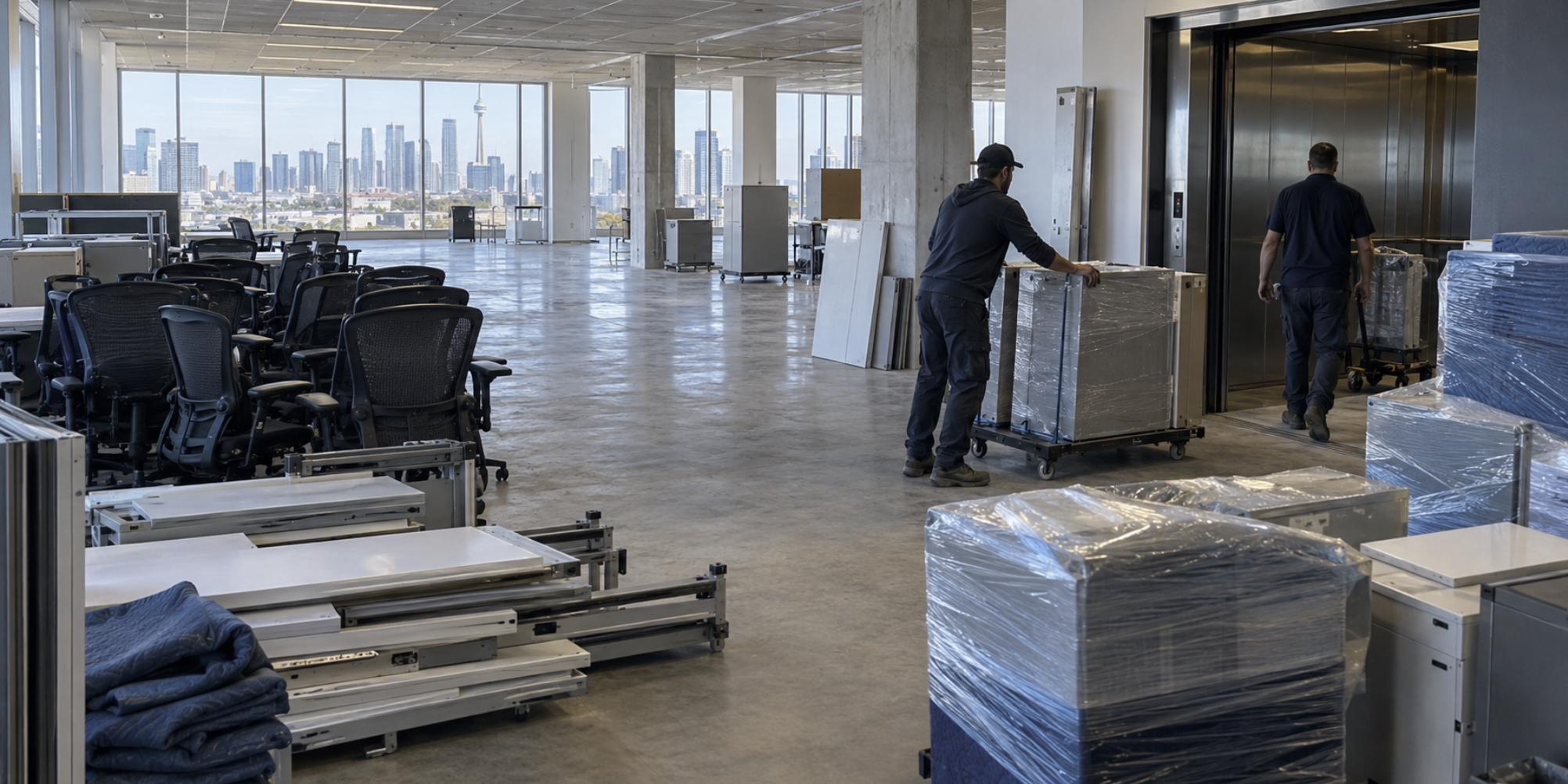
For a large office, the project may involve dismantling cubicles, removing filing systems, staging furniture, reserving freight elevators, coordinating building access, and transporting assets to several different destinations.
Professional office furniture decommissioning can combine inventory assessment, furniture removal, equipment disconnection, routing of assets, and final clearance when a business is vacating or restructuring a workspace.
When requesting a proposal, provide:
- photographs or an inventory
- the office location
- the approximate volume of furniture
- the date the space must be cleared
- any furniture that must remain operational until later
- known elevator, loading dock, or building-access restrictions
- the required condition of the space at handback
A good removal plan should tell you not only what the crew is taking, but when it is leaving and where responsibility ends.
Frequently Asked Questions About Downsizing a Business
Does downsizing always mean reducing staff?
No. A business can downsize its office footprint, inventory, equipment, product range, or other operating capacity without making employee reductions the centre of the strategy. The right combination depends on where the unnecessary costs actually exist.
How do you know which assets should be sold?
Start with assets that the future operation no longer needs. Then assess their condition, resale potential, and the cost of retaining them. Do not sell equipment solely because it has not been used recently if it remains important to expected demand or operational capacity.
Should you sell office furniture before moving?
Usually, surplus furniture should be identified before the move. That prevents the business from paying to transport furniture to the new location only to remove it again afterwards. Furniture being retained should be clearly separated from the liquidation inventory.
Can office furniture liquidation help reduce downsizing costs?
Potentially. Saleable furniture can create recovery that offsets part of the removal or transition cost. MGT's analysis of office furniture disposal costs and recoverable value treats resale as an important part of the net cost calculation rather than looking only at labour and transport.
What happens to furniture that cannot be sold?
Depending on its condition and available destinations, it may be donated, recycled, or disposed of. Establish those routes before the final clearance deadline so unsold furniture does not become a last-minute problem.
Can a business downsize without moving offices?
Yes. Downsizing can involve reducing inventory, equipment, furniture, or operating capacity while remaining in the same premises. However, clearing unused space only creates direct occupancy savings if the business is able to reduce or avoid the associated space cost.
Quick Recap
- Downsize for a defined reason: Determine whether the business is responding to a temporary problem or a permanent change in its operating needs.
- Protect what generates value: Do not remove equipment, people, or capabilities the smaller business still needs.
- Target unnecessary costs: Focus reductions on expenses and assets that no longer support the company's direction.
- Recover value from surplus assets: Assess furniture, equipment, and technology before treating them as disposal.
- Plan the office transition separately: Decide what stays, what moves, and what leaves before the removal begins.
- Use multiple disposition routes: Resale, donation, recycling, and disposal may all be required within the same project.
Ready to Downsize Your Office?
A successful office downsizing should leave your business with the space and assets it needs, without paying to store, move, or dispose of things that no longer serve the operation.
Michael's Global Trading provides office furniture liquidation services and office furniture removal services for businesses downsizing, relocating, restructuring, or closing offices across Toronto and Canada. MGT assesses the outgoing inventory, identifies resale and reuse opportunities, coordinates disassembly and removal, and helps plan the remaining furniture around the project's timeline.
Send us photographs or an inventory list, your location, and the date the space needs to be cleared. We'll assess what is leaving and build the liquidation and removal plan around your downsizing schedule.
Recommended Readings
Office Furniture Disposal Costs Exposed: Landfill Fees, Labour, and Lost Value
How Office Furniture Liquidation Supports Corporate ESG and Sustainability Goals
Recommended readings:

Blogs & News


Get started on
your journey with us.